Archive for the 'Writing Articles' Category

Nov 18 2008

Three urgent pieces of novel-writing advice

We provide advice about how to write novels, comic books and graphic novels. Most of my content applies to fiction-writing in general, but we also provide articles specifically about superhero stories.

  • 52% of the readers that took our interactive writing quiz admitted that they describe what a character looks like by having him stare at his reflection in a mirror.  Please don’t!  It screams “amateur.”
  • 45% of readers admitted to using food-centric scenes (like dinners, Elven banquets, etc).  That’s not necessarily a problem, but please make sure that your eating scenes are more dramatic than “pass the biscuits.”  If the food is the most interesting element of the scene, the scene is almost certainly boring.  No one started reading your book to learn what foods your elves like to eat.
  • 55% of readers admitted to overusing obscenities.  As a rule of thumb, please don’t use more than one obscenity in a sentence.   Please also try to limit the number of obscenities on each page.   If you use too many obscenities, the piece will probably suffer (even if you’re writing about Marines).  See this for an example.

3 responses so far

Nov 17 2008

Common Problems with Third-Person Narration

We’ve already discussed why beginning writers tend to struggle with first-person narration, but third-person narration has its own share of problems.

Continue Reading »

15 responses so far

Nov 15 2008

Common Problems with First-Person Narration

First-person narration is tricky. It often suffers from several major problems.

Continue Reading »

35 responses so far

Nov 13 2008

We’ve restructured our interactive quiz for authors

We shortened our interactive quiz to 40 questions and about 20-30 minutes.  If you’d like to get published, give it a try!

No responses yet

Nov 12 2008

Manuscript Killers: Immortal Characters

When I’m reading a novel manuscript, immortal characters make me roll my eyes.   


Continue Reading »

36 responses so far

Nov 07 2008

Writing Tip of the Day: Please Don’t Include Art with Your Query

Some authors make or commission sketches about their novel so they can visualize it better.  That’s fine, but please do not include any in the query package you submit to a publisher.  (If you’re writing a graphic novel, please see this guide to graphic novel queries instead).

Art will probably not make your novel query seem more appealing!

  1. It feels amateurish.
  2. Publishers pick manuscripts based on the author’s ability to spin an interesting story, not on his ability to visualize the characters or make them look interesting.  Consequently, any art you included would distract from your most important qualities.
  3. Even if you’d like to use your illustrations in a novel, publishers are wary about the cost of illustrations.  Author/illustrator Jane Eldershaw says that “it can be surprisingly difficult to talk publishers into using illustrations, even for non-fiction and gift books. I’d suggest (especially if you’ve never been published) that you not mention illustrations until you have a publisher who adores your prose. Then suggest they look at books that have been illustrated in the manner you envisage and wheedle.”
  4. Do you have sample cover-art you’d like your publisher to consider? If so, please show it after your manuscript has been accepted.

One response so far

Nov 07 2008

Writing Tip of the Day: Make Your Story Intriguing, Not Cryptic

Many stories create suspense by withholding important information (like the killer’s identity, in a mystery) until the end. But publishers usually reject works that are cryptic. How can you make your work intriguing (good) rather than cryptic (painful)?

Continue Reading »

23 responses so far

Nov 05 2008

Why Secret Origins Are Usually Awful

Occasionally, an author will breathlessly offer some revelation about a character’s origin.  (Luke and Leia are siblings!  Sylar is actually a Petrelli! That mysterious old man is actually a god!)  Secret origin stories are rarely effective.  If you’re doing a secret origin, here are the biggest potential concerns.  If you can avoid these, I think the secret has promise.

Continue Reading »

105 responses so far

Nov 01 2008

Superhero Nation: Novel Synopsis

OK.  We’re writing a rough draft of Superhero Nation for National Novel Writing Month.  If you’d like to beta-review our novel synopsis, we’d really appreciate that.  If you’ve already left an email or comment asking to be a beta-reviewer, we have also e-mailed this synopsis to you.

If you’re not sure what to write about, here are a few sample questions that may help you do a beta-review.

  • What do you think about the characters?  How might we make them more interesting, likable and/or dramatic?
  • Is the plot coherent?  How might we make it smoother?
  • What are some ways we could draw the plot out without making it feel padded?

UPDATE: I’ve made a diagram showing plot-links between the characters.

20 responses so far

Oct 30 2008

Titles to Inspire You!

Are you in need of a writing exercise?  Try writing a story with one of these titles.

  • Breakfast on the Rooftop
  • The Dream of Centuries
  • The Bride’s Got a Gun
  • Man Down!
  • Dancing in the Kitchen
  • The Beginner’s Guide to Nuclear Apocalypse
  • Bob’s College of Knowledge
  • Weirdbeard, California

24 responses so far

Oct 29 2008

We’re going all the way this year… and we need your help!

National Novel Writing Month starts in two days.  We’re going to finish our first novel manuscript.  We need beta-reviewers.

What this would entail: We’ll give you our novel’s outline, 2-3 pages describing what we envision happening throughout the book.  Over the course of the month, we will write chapters to bring that synopsis to life.  We’d like you to read these chapters and offer advice.  That might look like any or all of the following.

  1. Suggest where we might go from there.  Do you have any ideas about what the next few chapters might look like?
  2. Mention any glaring weaknesses in our story, characters, dialogue, plot, etc.
  3. Suggest any possible improvements.

So, what’s in it for you?

  1. Authorial networking. On any given day, I get between 30 and 40 manuscripts, comments and emails.  That’s on top of my writing, studying and thesis research.   So my time is really stretched.  However, if you help beta-review our work, I will assuredly make time for you.
  2. Altruism. We really need the help.
  3. Marketing. Your publisher may ask you to get other authors to review your work so that you can place favorable blurbs on the inside cover.  I’m not very fond of tying my credibility to other people’s work, but I’ll make an exception for a skilled author that has helped me in the past.

If you’re interested, please either leave a comment or e-mail us at bmckenzie05–at–gmail–dot–com.

7 responses so far

Oct 28 2008

Don’t Overuse Exotic Substitutes for “Said”

Beginning authors tend to overuse “said bookisms,” which are words used to replace the word “said.”  For example, in the sentence “I’m ready!” he declared, declared is a said-bookism.


Using more than a few said-bookisms per page will probably make the dialogue feel melodramatic and stilted (“I’m hungry,” he uttered). Some common said-bookisms are potentially distracting because they aren’t actually a way to speak.  For example, “I knew you’d come back,” she smiled lazily conflates two actions: the speaking and the smiling.   No, she didn’t smile those words.  It would be clearer and probably more publisher-friendly to change the phrase to “she said with a smile” or give the two actions their own sentences.


Additionally, animal-sounds are unusually annoying.  It doesn’t take much of him clucking and her purring to sound absolutely ridiculous.

Continue Reading »

29 responses so far

Oct 27 2008

Writing Tip of the Day: Make Your Characters Uncomfortable

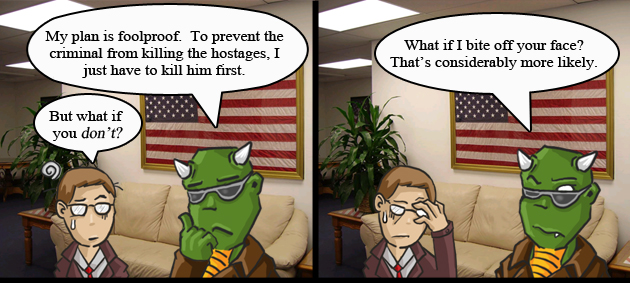
If your characters are comfortable, chances are that the story isn’t doing anything interesting. “Could you pass me a crumpet, dearie?” Far too many manuscripts get bogged down in characters chatting. Scenes that focus on chatting are typically boring and pointless. Fortunately, you can easily fix these scenes by adding discomfort and conflict. What if the two conversants hated each other but couldn’t avoid talking? What if John and Margaret had utterly failed on a joint project at work and they could only keep their job by moving past what had gone wrong? Or what if John were obnoxiously, madly in love with Margaret? Suddenly the scene has potential. Dramatic possibilities abound.

Here’s a webcomic to help remind you to keep things uncomfortable.

One response so far

Oct 27 2008

The Northern Hemisphere may be slumping towards an icy, bleak winter…

Published by under Writing Articles

…but Summer Fun Cthulhu is rocking out in style!

2 responses so far

Oct 25 2008

Your Title is Bad, But You Can Fix It (Part 9)

Cadet Davis reviews and revises the titles of 30 manuscripts submitted to a writing workshop. This will help you evaluate and improve your titles.

Continue Reading »

74 responses so far

Oct 24 2008

Quiz: Is Your Manuscript Dead on Arrival?

This quiz will help you diagnose some common manuscript problems. If you’re not sure why your answer was right or wrong, please see our explanations either by waiting until the end of the quiz or hitting “previous question” during the quiz.

Is Your Novel Manuscript Dead on Arrival? » Create A Quiz

If this quiz helped you, submit it to Stumble!

158 responses so far

Oct 24 2008

When parodying superheroes, you can do better than lampooning their clothes

Superhero parodies are very hard to write. Generally, you can’t parody something that treats itself as ridiculous to begin with.  This means that poking fun at ridiculous elements of superhero stories, like what superheroes wear, is usually unsuccessful. Fortunately, many elements have more comedic potential because the stories take them seriously.

1. Superhero origin stories have always been outlandishly tragic, but since roughly 1990 it has just been ludicrous. Instead of just watching his loved ones get murdered, the hero might get betrayed by the CIA, set on fire, sent to hell and then return as some sort of crazyass demon-hunter.

2. As superhero stories progress, the writers run out of material and the likelihood that the stories will take bizarre twists approaches 100%. He’s a clone! His parents were superspies! His aunt marries a supervillain! His girlfriend falls for a werewolf! He grows six arms! He writes his girlfriend out of history by making a deal with the devil! And that’s just Spiderman. Don’t even get me started on the total strangeness surrounding Jimmy Olsen.

Continue Reading »

4 responses so far

Oct 23 2008

The “Recent Comments” Widget Works!

In the four weeks since we’ve added the Recent Comments widget, our comment-traffic is up about 800%.

Continue Reading »

2 responses so far

Oct 23 2008

A few notes on punctuation use in novels

Continue Reading »

3 responses so far

Oct 22 2008

“How Can I Make a Character With Mental Disorders Work?”

Continue Reading »

61 responses so far

Oct 22 2008

“How far in the book should I introduce my main character?”

Unless you have a compelling reason to do otherwise, I’d say the start of chapter 2 at the very latest.

Continue Reading »

17 responses so far

Oct 22 2008

Three Qualities of Interesting Villains

One of the signs that your villain doesn’t suck is that he’s interesting enough to handle a scene on his own.  No, we don’t need to hear about his pathetically traumatic family history or the byzantine machinations of his evil organization.  Readers just need some sign that your villain has the competence, style and/or ambition that mark a good villain.


Competence

Your villain should not be out of the hero’s league. In fact, for most of the story, the villain should probably be winning against the hero.  One common misconception is that the hero will seem less impressive or likable if the villain beats him a few times.  No!  A hero that defeats a crazy-competent villain will resonate more.  For example, the only reason anyone remembers Luke Skywalker is because he defeated Darth Vader.


Fortunately, you can make your villain competent fairly easily. When your hero attempts some course of action, take 15 minutes to list anything that could go wrong.  Then list anything that your villain could do to make the hero fail even more spectacularly.  Your villain only has to exploit one glaring weakness in the hero’s plan to look competent.  Does the hero’s plan require logistical support from his Batcave?  Whoops. Even if your villain can’t take down the Batcave, he could try something like an EMP or sunspots to interfere with communications signals. Is the hero unable to teleport around town?  Throwing him off with a decoy could buy the villain enough time to carry out his real plan.


Style
Style is harder to pin down than competence, but there are still a few discernable signs of style.  A stylish villain tends to dominate his scenes, even if he doesn’t have many lines.  For example, there were a few scenes in the first season of Heroes that Sylar dominated even though he wasn’t actually present.


One scene that particularly sticks out is when Parkman and his FBI partner were fumbling around one of Sylar’s icy murder-scenes.  First, there’s the horror factor.  Sylar is obviously an extremely depraved killer.  But more importantly, the gruesomeness of the murder is contrasted with the incompetence of the cops.  They have no idea what’s going on.  Sylar was more of a presence because he was obviously playing out of their league.


Ambition
I recommend giving your villain an overarching and genuinely sinister plan.  If your villain’s plan is only to get revenge against a few people, the stakes of your hero failing will be very low.  For example, the first Spiderman movie dropped the ball on this one.  What would the stakes of Spiderman not fighting the Green Goblin have been?  Pretty much nothing, unless you were on the board of directors of OsCorp.


This doesn’t mean that the villain’s plan has to endanger the world or universe.  That gets cheesy very fast.  But this goes to competence: a villain that’s only playing for small stakes (like trying to kill a few OsCorp businessmen) probably won’t seem very competent or frightening.  In contrast, Dr. Octopus’ plan was more ambitious and interesting even though it wasn’t particularly evil.  He wanted to perfect a crazy-ass scientific theory to redeem himself for killing his wife the first time.  Octopus’ plan had significantly higher stakes for Spiderman because he endangered many more innocent victims.  (Sorry, ruthless businessmen, but readers just don’t care about you).

192 responses so far

Oct 15 2008

Do You Have Any Writing Questions?

Unfortunately, work is crazy this week and I haven’t had time to think of any writing articles.  If you have any writing questions or topics, this would be a great place to post them.  For example, some of the questions we’ve answered before are…

35 responses so far

Oct 15 2008

Six Openings That Usually Fail

Please don’t open your novel with any of these.


1. The main character introduces himself to the reader (“Hi, my name is ____, but you can call me ____.”) Isn’t there anything more interesting you can tell us about the character than his name?  If not, you should probably get back to the drawing board.  This type of opening is also annoying because it’s usually the only part of the book that’s addressed to the reader.


2. The main character wakes up and does his morning routine. Instead of showing your character waking up, getting dressed and then having breakfast, why not skip to the interesting part?  Furthermore, virtually everyone eats breakfast and gets dressed.  Please show us something distinct about the character.


3. The main character is immediately plunged into danger. OK, so the hero is getting shot at.  Why should we care?  If you go down this route, make sure we’re emotionally invested in the character.  Introduce the character a bit before throwing him to the sharks.


4. Something unusual and cryptic happens in the first half-page. For example, a mysterious woman hands the hero a baby and then walks away.  Typically, this type of opening could be improved by spending more time describing what the hero’s life is like before the strangeness starts.  I’d recommend that novelists spend at least half a chapter describing the hero in his element.  Then, when you shake up the status quo, we will have a better feel for the character moving forward.  For example, CS Lewis described his characters for several chapters before bringing them to Narnia.


5. The narrator delivers a geography lesson. I recommend showing us your characters before the world, particularly if your world is similar to Middle-Earth.


6. The opening sentence uses pronouns for “suspense.” “Until it happened, I had no idea how badly they had screwed me.”  This narrator is obviously hiding what “it” and “they” are.  That’s not suspenseful, just annoying.  Make sure you give us enough to understand what’s going on.  For example, we could rewrite that sentence as “until the dragon’s face exploded into a gooey mess, I had no idea how badly Adventurers, Inc. had screwed me.”   Please remember to let readers know everything that the point of view character knows.

123 responses so far

Oct 12 2008

Writing Tip of the Day: Don’t Forget the Fun

One of the most common reasons that superhero stories fail is that they try too hard to be serious and end up killing the fun.  This does not mean that a serious story has to be unfun (see Wild Cards).  But the line separating seriousness from insufferability is very fine.  Here are some signs that you’ve crossed it.

  • The story treats being super as if it is a chore or unpleasant burden.
  • All of the characters are completely familiar with having superpowers and/or being superheroes.
  • The characters are overly emo (Heroes).
  • The language is impossibly dense and/or melodramatic (The Superhero’s Closet).
  • The story pushes a political agenda (Civil War).

For example, let’s compare Heroes to Spiderman here. Tracy discovers her ice-powers by accidentally killing someone and tests them by destroying a rose.  In the Spiderman movie, Peter Parker discovers his superpowers by finding out that he no longer needs glasses and tests them by trying to sling his way across town in a comically inept fashion.  Parker’s story features enthusiasm and positive energy.  Tracy’s story is laced with emo wangst. It doesn’t help us relate to her or see through her eyes.  Worse, it prevents viewers from wanting to see through her eyes.

2 responses so far

Oct 09 2008

“Yet Another Comics Blog” argues against origin stories

Yet Another Comics Blog argues that origin stories are mostly a distraction from the real action.

The origin is not the interesting story; it’s background information. If the information in the origin is important to the story you’re telling, then you can go back later and fill in for the reader. But don’t start with an issues-long origin…

Think of all the good genre movies you’ve ever seen. How many begin with a long origin sequence? Did Raiders of the Lost Ark start with 45 minutes of young Indiana Jones getting his PhD in archaeology? Did Star Wars begin with the origin of Darth Vader?

I disagree.  A character is usually the most human and relatable during his origin story.  Additionally, for most superheroes they also provide an irreplaceable opportunity to introduce the audience to the character.  For example, an author couldn’t explain who Spiderman is without showing why his uncle died.

Also, Star Wars did not begin with the origin of Darth Vader, but it did explain Luke’s origin at length.  Over the course of three movies we saw a farmboy grow into the savior of the universe.  It worked quite effectively.  I’d also venture that the first Matrix movie benefitted from Neo’s origin story.  If it had started with Neo after he had been released from the Matrix, it would have been horribly confusing.

The author praises Batman but criticizes Spiderman and Superman for spending too much time on origin.  But these are exceptional cases.  Usually, the audience is completely new to the backstory.  If so, then explaining the character’s origin is probably essential to introducing the audience to the world and/or the character.

14 responses so far

Oct 09 2008

Improving a Weak Quote

I found this Halo quote on TV Tropes.

Cortana: Just one question: what if you miss?

Master Chief:  I won’t.

The dialogue needs more flair.  If I wrote a similar conversation between two Superhero Nation characters, it might look something like this.

2 responses so far

Oct 08 2008

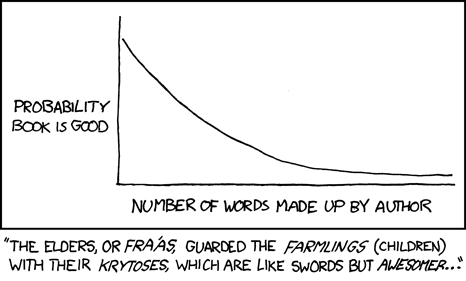
Invented words are painful

(Courtesy of xkcd).

Please don’t invent words when an immediate English translation is available.

3 responses so far

Oct 06 2008

A comic that looks interesting and well-written: ODD Squad

The Odd Squad is a witty take on paranormal agencies like the Men in Black.  Here’s the synopsis:

“As the new head of the Office of Dimensional Defense (O.D.D.), Charlotte Becker fails to get her first pick among the department’s new recruits. When the best she can get turns out to be a geeky blogger, a flaky psychic, and her air-headed sister, she faces some stiff odds—namely a competing agency who doesn’t want the truth exposed.”

I love the competing agency angle, but the synopsis is not as smoothly written as the comic.  Here’s a sample page for ODD Squad.

The FBI agent is remarkably engaging even though he says very little.  He has great chemistry with the paranormal researcher.  But I have two concerns.  First, the lettering’s not easy to read.  Second, the story’s main character (the researcher) has none of the laugh-lines and doesn’t seem well-written.  Her  jokes, like the quip about her boyfriend, completely fizzled.  I suspect the story will suffer when the FBI agent is absent.

One response so far

Oct 05 2008

This year, we will throttle Seattle

Published by under NaNoWriMo

In terms of productivity, Seattle’s authors have dominated the National Novel Writing Month for two years in a row.  But this year the furious scibblers of northern Indiana will strike fear into their hearts!

CADET DAVIS ADDS: Northern Indiana’s secret weapon against Seattle is unemployment.

No responses yet

« Prev - Next »