May
02
2010
The difference between “anyone” and “any one” is simple but frequently missed. “Anyone” is a synonym to “anybody,” so use “anyone” in a situation where “anybody” would also work. If anybody does not fit, use “any one.”
- Any one of Jim’s girlfriends would murder him if she found out.
- Anyone could have told Jim that having four girlfriends was probably an unwise move in terms of not getting murdered.
Also, please keep in mind that both are singular. “Jim’s girlfriends would murder him if they found out” vs. “Any one of Jim’s girlfriends would murder him if she found out.”
Oct
28
2008
Beginning authors tend to overuse “said bookisms,” which are words used to replace the word “said.” For example, in the sentence “I’m ready!” he declared, declared is a said-bookism.
Using more than a few said-bookisms per page will probably make the dialogue feel melodramatic and stilted (“I’m hungry,” he uttered). Some common said-bookisms are potentially distracting because they aren’t actually a way to speak. For example, “I knew you’d come back,” she smiled lazily conflates two actions: the speaking and the smiling. No, she didn’t smile those words. It would be clearer and probably more publisher-friendly to change the phrase to “she said with a smile” or give the two actions their own sentences.
Additionally, animal-sounds are unusually annoying. It doesn’t take much of him clucking and her purring to sound absolutely ridiculous.
Continue Reading »
Oct
25
2008
Cadet Davis reviews and revises the titles of 30 manuscripts submitted to a writing workshop. This will help you evaluate and improve your titles.
Continue Reading »
Oct
08
2008
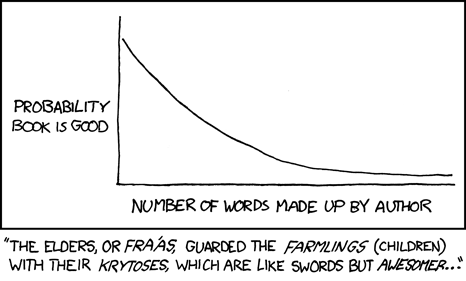
(Courtesy of xkcd).
Please don’t invent words when an immediate English translation is available.
Aug
05
2008
From Wired.com: “Thomas Edison, never shy about exploiting a situation to his advantage, especially if it could cripple a rival, therefore built the electric chair to operate on alternating current [the preferred system of his rivals]. By associating the Tesla-Westinghouse current with something as unpleasant as capital punishment, Edison hoped to turn public opinion his way. He even suggested replacing the new coinage, electrocution, with ‘to be Westinghoused.’ It never caught on.”
That invented use of “Westinghouse” is brilliant. Which words could you repurpose for your fiction?
Aug
05
2008
If you ever come across one of these words as you rewrite, please replace it with something more specific and spicy.
- Good
- Nice
- Alright
- Well
- Mean (adjective)
- Interesting
- Vivid (hat-tip to anonymous commenter)
- Of course (hat-tip to T3knomanser)
- Smart (hat-tip to Jacob)
Did I forget any words you love to hate?
Aug
02
2008
When you try to sell your work to a publisher or readers, please do not use the word “parody” interchangeably with “comedy.” A parody imitates the style or plays on the conventions of an author/genre /work to make fun of it. Most comedies are not parodies. There are two common reasons that authors may misuse the word parody…
Continue Reading »
Aug
01
2008
This short article will help beginning novelists avoid another five common mistakes that will usually cause publishers to throw out a manuscript.
Continue Reading »
Jul
14
2008
When an interjection like “well” starts a sentence, it’s usually wasted space. If you start sentences with any of these common offenders, double-check to make sure that they actually contribute something to the sentence. Otherwise, please remove them.
- Well
- You know
- Oh
- Like
- Umm
- OK
- I mean
- Seriously
- Basically
- Yeah

