Sep 17 2008
Wired Ranks the 7 Worst Superhero Names
I’m pleased that they didn’t miss She-Hulk. You can see the follow-up article here.

Sep 17 2008
I’m pleased that they didn’t miss She-Hulk. You can see the follow-up article here.
Sep 05 2008
John August did a post on writing a plot that isn’t contrived. He focused on the role of coincidence. I found it highly useful…
Given a choice, try to find cause and effect. One event happens because of something else we’ve seen — ideally, something the hero himself has done.
Instead of having the hero accidentally overhear a key conversation, get him actively trying to listen. Or have an interested third party steer him in that direction — perhaps for his own reasons. At every juncture where a reader could ask “Why did that happen?”, try to have an answer that isn’t, “just because.”
CADET DAVIS ADDS: The most contrived plot I can think of is Heroes season 2. Please consider the following…
Jul 04 2008
Have a happy 4th of July!
FIRST COMIC — PREVIOUS COMIC — NEXT COMIC
FIRST COMIC — PREVIOUS COMIC — NEXT COMIC

Jul 03 2008
I submitted a potential rewrite of our introduction to the Critters Writing Workshop. It’s very short (2 pages) and I expect that we’ll eventually expand it to about 5. Currently, it’s rated PG-13 for adult language, but we’re considering modifying it to PG.
Jul 02 2008
The creator of Heroes, Tim Kring, has promised that season 3 will have more villains. Yes, more characters… that’s exactly what Heroes needed.
“You’re going to see a lot of bad guys,” he said to Sci Fi Wire. “We’re playing off the idea of our characters as heroes or villains. So it’s really the duality of good and evil.” T.K., I will see your duality of good and evil and raise you character development, interesting traits and a well-rounded cast. For one, I’d start by killing off about half the cast…
May 19 2008
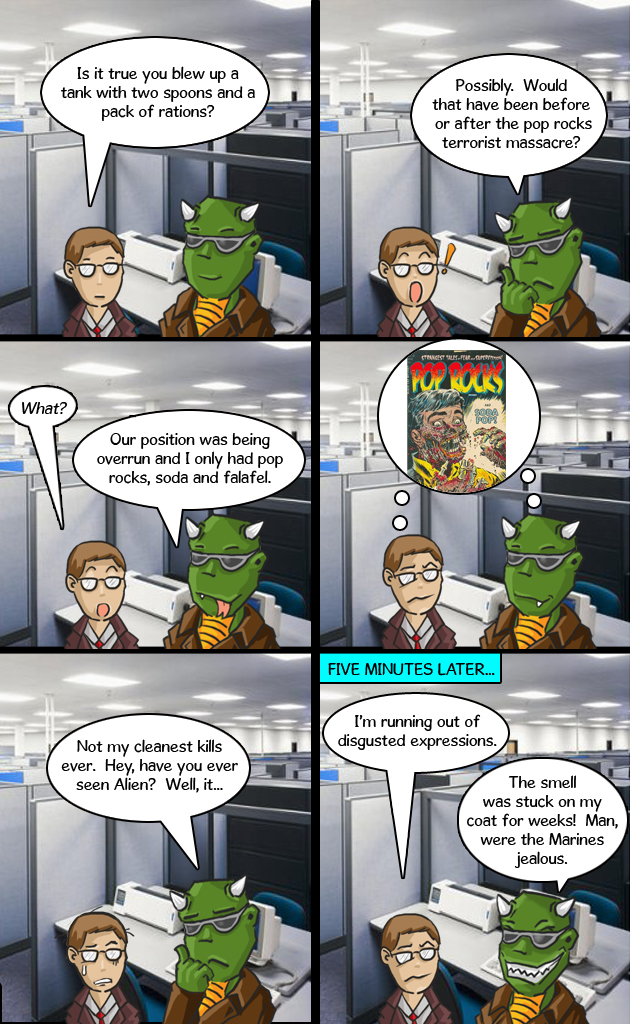
Agent Orange: Kids today are so hard to please.
Agent Black: I don’t even want to think about how you might know that.
Agent Orange: Yesterday…
Teacher: Class, today our guest speaker is Agent Orange.
Agent Orange: I’m a Special Investi-Gator.
Teacher: Could you explain what it is you do?
Agent Orange: Are you sure? There are kids here.
Student 1: Have you ever killed anyone?
Agent Orange: Laws need claws or they’d just be words.
Student 2: How many people have you killed?
Agent Orange: The confirmed score or a rough estimate?
Agent Black: …
Agent Black: Suddenly I have questions of my own.
Apr 25 2008
Superheroes should never ask “are you thinking what I’m thinking?” The answer is never helpful.
But where could you find that much nitroglycerin at this hour?
–Dr. Darpa
Unless your IQ has tripled since we’ve last spoken, probably not.
You are now.
–Mr. Mental
Don’t flatter yourself.
–Paingod
Apr 25 2008
Science plays heavily in many superhero stories. So, today, instead of coming up with some pithy quote about science, we’ve used others to do so for us.
What is science?
Hocus pocus, but with less hand-waving.
— Agent Orange
Always being within a carton of baking soda of a doomsday device.
— Dr. Darpa
Like Hollywood, except without the beautiful women, oversized budgets and snappy outfits. Actually, it’s not like Hollywood at all, besides the explosions.
–Dr. Savant
A series of triumphs over unpleasant realities.
— Jacob Mallow
Pretty awful. Stick to game theory.
— Catastrophe
Apr 06 2008
B. Mac gave me this to post. He says he will be healthy enough to return to full-time status within a few days.
Agent White, junior recruiter: Mr. Smith, I have no doubt that you are an excellent IRS auditor, but I’d like to know more about how an accountant might be qualified for this agency. What about killing. Have you done any of that?
Gary Smith: No, sir.
Agent White: Have you ever seen someone die brutally? A de-limbing, perhaps?
Gary Smith: No, sir.
Agent White: I see. You seem like an excellent fit… for the IRS. I’m going to do you a favor and ask that you leave now. You would break in ten minutes here and you probably wouldn’t even be the first.
Gary Smith: …
Gary Smith: Is that a request or an order?
Agent White: …
Agent White hits his intercom button.
Agent White: Agent Orange, could you step inside, please?
Agent Orange, a hulking mutated alligator, enters the room.
Agent Orange: Greetings, mammals! Mammal-White, Mammal-Smith.
Agent White: Sir, could you please describe to Mr. Smith what your job is here?
Agent Orange: Indeed! I’m the head recruiter and trainer. I determine who enters training and then how best to systematically destroy them. We’ve reduced our mortality/psychosis rate to a historically low 6%!
Agent White: Mr. Smith, so far Agent Orange has broken six Navy SEALS, five Force Recons, ten Army Rangers and so many Special Agents we’ve stopped counting.
Gary Smith: But no accountants, I bet.
Agent Orange: …
Agent Orange: When are you available to start?
Apr 05 2008
“I only gradually realized that Gary Smith was wily for a mammal. That should have been obvious. He was an accountant and, as a rule, accountant-mammals are masters of chicanery and deception. (That is why they, like lawyers and journalists, receive graduate degrees: it takes years to learn the arts of subterfuge).”
–Agent Orange
Jan 31 2008
One of the Google searches that brought someone to Superhero Nation was “what do alligators do all day?” Agent Orange, our resident mutated alligator, provides his daily schedule.
1 AM: I respond to a WMD scare in Surf City. (It was just a death ray).
2: A purported representative of the British government calls, asking for urgent help “to stop an impending act of anti-supervillain activity.” Terrorist! I hang up.
2:30: Britain reports that Doctour Nefarious just carried out “anti-supervillain activity” at Big Ben. The reports don’t mention which supervillain he acted against, but I’m betting Jihad Joe or Paingod.
2:35: I call the Ministry of Defense and ask them to pass along my congratulations to Nefarious for turning on his evil compatriots. They swore and hung up on me. (And they wonder why we declared independence).
3: A genetically-engineered slime monster attacks Surf City. Dr. Darpa suggests that a salt-spray will kill it, but he doesn’t mention that salting it will send slime shooting for blocks in every direction.
3:10: Showering.
3:30: Still showering.
3:45: I get dressed. I’m feeling dangerous today, so I reach for a black tie instead of my usual navy blue.
4: I brush my teeth. (Yeah, I brush my teeth, too—it just takes more time).
4:30: Still brushing.
4:45: I check my voice-mail. IRS Agent Percy Leguin called again to complain that the Office of Special Investigations is doing too much “showboating,” by which he means investigating crime that Americans actually care about. The bitch insinuates that OSI agents couldn’t handle IRS work.
5: A citizen that incorrectly filled out a 1040-DX Schedule ECQ gets a very special no-knock home visit about why filling out a proper 1040-DK Schedule FIS is important. I’m sure it’s a mistake he won’t make again.
6: Downstairs, I encounter Agent Black and Captain Carnage discussing female-mammals. For reasons unclear to me, talking about mammalian matters makes Agent Black pathologically forgetful. Unsurprisingly, as soon as he sees me, Black mentions that he’s forgotten his ammo. When I offer to go find some for him, he smiles. (I’m so helpful).
6:30– I come back with the ammo, but Black’s gone. (Mammals). I’ll find him later.
7– As part of the ongoing Friendly Skies program, I get a free ticket to New York. Having a uniformed federal agent on a plane tends to terrify mammals, so I just told anyone within earshot that I was just scamming a first-class ticket. That calms them down considerably. (Mammals).
7:45– Mike is also on the plane with me! He is conspicuously surly and says that “I’m going to carpet-bomb your neural nodes if you ask about the Gators game again.” I don’t remember having spoken to the mind-wiper earlier today. I decide that until Mike gets unsurly, he doesn’t deserve to talk about the Gators.
8– On my way to the office, I stumble upon two gunmen attempting to rob a Caribou Coffee. They are not successful.
8:05– Waiting for NYPD.
8:10– Still waiting.
8:15– I assume that I’ll be here a while. I ask the cashier which species of caribou they have on hand. I’m especially partial to Rocky Mountain caribou, but even Alaskan elk are better than whatever else you can find in New York.
8:17– The cashier admits to me that Caribou Coffee does not actually sell caribou. I make a note to inform the Better Business Bureau of bait-and-switch advertising– they lure in unsuspecting customers with promises of caribou and then sell them coffee instead. (Mammals). Two NYPD officers walk in; I trust that they will take care of this criminal cesspool of deception and lies.
8:45– I reach the local police station and start filling out paperwork related to the coffeeshop arrest.
10– Still paperworking.
10:30– A detective asks me if I’d like some coffee or something. Unless coffee means caribou, no.
10:45– A captain interrupts me. Space slugs are clogging the Hudson again. I tell him that I’m still doing paperwork, but he calls my bluff by offering to handle the paperwork himself. I ask which way it is to the Hudson.
10:55—Goddamn. This was a new suit.
11: I walk down to the Office’s New York branch. Raul, our lobby guard, starts quizzing me with questions designed to weed out potential shapeshifters.
11:05: “Raul, I am coated in slug slime. Let me in immediately or you will regret it.” “What does the 5th amendment say, sir?” “Here’s the abridged version. No person shall be deprived of life or limb without due process of law. Without due process, Raul.” He lets me in.
11:45– Still showering.
12 PM: The University of Florida calls. They want help creating a tagline for Albert the Florida Gator’s new clothing line. They like “Prepare to Get Swamped” but think that “Chomping Your Ass Since 1908” sends mixed messages.
12:15: They don’t like “Be a Gator, Not a Hater” either.
12:30—I walk down to the cafeteria and find… Agent Black! I hand him his ammo. He gives me a confused look. He has not only forgotten his ammo, he has forgotten that he has forgotten it. I swear! He’d forget his tail if he had one.
12:35—“He’d forget his tail if he had one.” Aha! I’ve stumbled onto the reason that Agent Black doesn’t have one.
Jan 29 2008
The gist of the lawsuit is that Heroes supposedly ripped off a preexisting plotline that where an artist painted the future and included the (possible) destruction of two New York City landmarks.
If this lawsuit works out, I’m going to sue every romance publisher because they’ve all ripped off a story I wrote last year where a guy and a girl struggle through adversity and finally get together.
(Wait a minute…)
I’m not sure I can think of a superhero story set in the real world where a New York landmark isn’t endangered. In fact, superhero stories are probably more likely to endanger NYC landmarks than romances are to show guys and girls getting together, because some romances are tragedies).
As as for the supposed ripping-off of a superpower (painting the future), again pretty much every superpower is a direct and blatant ripoff of something that’s already been used. Some of the superpowers used on Heroes are…
Superstrength
Regeneration
Flying
Mind-reading
Groundbreaking stuff there!
Jan 28 2008
This is a glossary of terms related to comic books. (See the Superhero Nation-specific glossary here).
Jan 26 2008
I’ve been using some random story generators. Usually I like laughing at how strange these get, but almost invariably I get something that’s uncannily like my writing and it makes me feel bad. The worst is that it usually starts off far enough away that you can laugh at it, but then it inches more and more towards Superhero Nation.
The story is about a secret agent who is in debt to an artificial life form. It starts in a large nation on a war-scarred planet. The story begins with someone giving a test and ends with smuggling. The side effects of faster-than-light travel play a major role in the story.
This is an action adventure. The story is about a crazed football fan who is actually an alien entity. It starts on a dying planet. The issues surrounding first-contact with an alien species is a major element of the story.
The story is a screwball comedy about a secret agent who is best friends with an investor. It starts in a solar-system-spanning nation. The effect of technology on humanity is a major element of the story.
This is a tale about confusion. The story is about a lawman. It takes place in a global empire [hey!]. The story begins with someone questioning authority.
This is a story about questing. The story is about a starship security agent and a dispirited CFO [close enough]. It starts in a solar-system-spanning technocracy. The story ends with someone writing a book.
The story is set in a ghetto. The story takes place ten years in the past. The story must have a drug cartel involved in the middle. The story must have a cube appear in the end. A character robs someone.
(What do you think this is, Everybody Dies?).
Character Generators
Note: not all of these are gramatically correct. Deal with it!
The upper-class fop is on the run from a government conspiracy run by wacky but innocent football players. [Lash].
The rare good member of an otherwise irredeemably violent race somehow manages to be a superhero. [Agent Orange]
The morally ambiguous brilliant scientist is driven insane by their strange powers and needs a friendly alien to find meaning. [Jacob Mallow]
The wacky yet emotionally detached chemist who is given superhuman powers in an illegal scientific experiment and is just this side of crazy [Dr. Berkeley/Catastrophe]
The philosopher is a secret horror in the shadows of society that works as an assassin against The Man. [Gigas]
The loveable cop meddles in things Man was not meant to know. [Agent Black]
The gung-ho military officer is forced by a government conspiracy to only pretend to be incompetent. [Captain Carnage]
The beautiful nerd girl no one notices because she has glasses who is a softy at heart and whose scientific endeavors have guided the heroes on their quest with weapons of mass destruction. [Dr. Darpa]
The friendly bureaucrat acts as an assassin against the forces of darkness. [Nope. But I’m thinking about it now.]
Jan 20 2008
If you’re writing a superhero story, don’t let your superpowers fall into these traps.
1. The hero’s powers can’t be used creatively. Readers really want to be surprised, so it’s very important that the powers be versatile. If your character is only superstrong, you can only surprise them by using different things as weapons. That gets tedious fast. (Watch a Superman or Dragon Ball Z fight scene). Test your superhero against some of these situations. Can he get through them in an unexpected way?
2. The character’s limits are hard to grasp. In Heroes, a head wound will permanently kill the regenerating heroes, but a nuclear explosion won’t. Huh?
3. The character’s strength fluctuates arbitrarily. Most Superman cartoons feature two battles. Superman will lose the first bout (to raise the stakes) but he’ll win the second. He hasn’t gotten any stronger, so why does he wins the second time? That usually feels unsatisfying.
4. The superpowers are hard to understand. Ideally, you can explain each hero’s powers in a brief sentence. “He has spider-powers, like slinging webs and climbing and sensing danger” is OK. “She can control the weather” is even better. Please stay away from heroes that have many unrelated superpowers. What’s the connection between eye-beams, cold breath, flight, superstrength and x-ray vision? It sort of works for Superman because readers are exposed to him, but it is likely to ruin a superhero story that is completely new to its readers.
5. He’s overpowered. Superman is the best example of this. He can only have interesting fights with supervillains. (Theoretically, he could fight thugs armed with kryptonite, but Superman limping around isn’t much of a fight). If your character is completely immune to bullets and other common weapons, it will be hard for you to challenge him. Also, humans are vulnerable and we relate more to (somewhat) vulnerable heroes.
6. The hero’s superpowers ruin the drama. In particular, time travel, reading minds, erasing memories, and resurrection are particularly bad here.
Did you like this article? If so, please do me a favor and share it on Stumble.

Jan 14 2008
This article will teach you how to write exciting fights.
1. Immerse us in the scene. Engage as many senses as possible, particularly the visceral ones (touch, smell, taste). For example, if the supervillain dropkicks his sister, you could work with the impact he feels, the impact she feels, the secondary impact of her slamming into something else, possibly the smell and/or taste of blood, and anything related to the superpowers of either. (Dropkicking the Human Torch should be a different experience than The Thing or Reed Richards).
Additionally, avoid anything that makes your readers wonder what’s happening. It may help to create a diagram of the scene so that you know what’s happening. One frequent area of confusion is how far away the characters are from each other.
2. Don’t put in too many characters. Each additional character dilutes the fight and makes it harder to visualize the fight in real-time. I’d recommend capping your fights to 2-4 combatants at a time. If you want more fighters, I’d recommend writing the battle as a series of more limited duels rather than a battle royale with tons of fighters. If you have too many characters in a fight, it will probably lead to a fight that flits between each character, not sticking around long enough to show them doing anything interesting. (See Soon I Will Be Invincible).
3. Unlike comic books and movies, a novel does not accomplish much by having the hero mow down waves of faceless henchmen or creatures. A novelist doesn’t have visual special effects to show off. The main advantage of a novel is that its length allows it to sustain a deeper plot and better-developed characters. Fighting anonymous and hopeless enemies does not play to these strengths.
4. Be creative. How do your characters interact with the scenery? Brainstorm a few items or props that are in the scene and try to work in a few when a combatant gets desperate. Using props helps remind readers that the characters aren’t fighting in a vacuum.
Also, try to have your hero use his powers in an unexpected way. We’ll expect a shapeshifting hero to copy a guard or the villain to infiltrate the villain’s lair and rescue his girlfriend. But we’d be more surprised if he copied his girlfriend and got captured in her place.
5. Let your hero improvise. Throw a few wrenches in his carefully laid plans. If your supervillain really is a genius, surely he will anticipate some of the things your hero will try and prepare accordingly. (The forcefield generators will be within the forcefields, dammit!)
6. Be suspenseful. These elements should help.
–Stealth and desperation. Typically, heroic efforts that are stealthy and/or desperate are more suspenseful because any false step could result in failure. In contrast, it’s less suspenseful for a hero to barrel into the villain’s lair because readers know that there’s no chance a faceless mook will kill the hero. But the faceless mook actually DOES present some risk to a stealthy hero that cannot afford to be seen–it’s still not likely that the mook will stop the hero, but he could alert somebody that might.
–Ticking clocks. If the hero has 15 minutes to defuse the bomb or two days to stop the villain from taking over the world, that adds urgency to the plot. My favorite example of this was D.O.A., where the main character gets fatally poisoned and has to solve his own murder.
–Strong side-characters. If we feel for the damsel-in-distress, we’d care a lot more whether the hero can rescue her. We’re more likely to feel for her if she’s well-developed and has a distinct personality. I recommend looking at Teri Hatcher’s Lois Lane in Lois and Clark: The New Adventures of Superman.
–Suicidally determined heroes. If the audience knows that the hero’s only goal is beating the villain–not coming home alive–then it raises more doubt about whether he will survive. Whether he does or not, there will be more suspense. I’d recommend checking out Pacific Rim here.
7. Keep it as short as possible. Generally, fights should be the climax of their chapters, rather than the bulk. Dragging out a fight scene for pages typically feels pretty tedious. The worst-case scenario is that the fight will feel like a scrolling list of hits the hero and villain are landing on each other. I’d recommend checking out the last 20 minutes of Man of Steel here. Failure.
Jan 10 2008
Agent Orange: At the Office of Special Investigations, “Chariots of Fire” isn’t just a classic
film. It’s also the name of our driving school.
Jan 08 2008
It’ll have ridiculously confusing time travel, wholly implausible use of a space station as a doomsday device, and more national landmarks than you can shake a standard-issue NASA laser pistol at. But Hollywood will want a name that can appeal to a global market. I’ll call it… Planet of the Capes.
Jan 05 2008
Are you writing a novel or comic book about a powersuited hero, like Iron Man or Steel? Powersuit stories often suffer from the following problems, many of which are easy-to-fix.
Jan 05 2008
Beat’em-up superheroes like the Hulk and Superman often suffer from these six problems.
Jan 03 2008
This article will help you design your superhero’s appearance for a comic book or novel cover-art. No matter what your style is, you can avoid these 9 mistakes that cause a superhero’s appearance to sink the story.
Common Flaws of Superhero Appearances
 Our RSS Feed