Archive for the 'Writing Superhero Stories' Category

Apr 12 2009

Are you better-suited to write a superhero novel or a comic book?

We provide advice about how to write novels, comic books and graphic novels. Most of my content applies to fiction-writing in general, but we also provide articles specifically about superhero stories.

Many authors here aren’t really sure whether they want to write a superhero novel or a comic book.  Here are a list of factors you should consider when deciding which one will work better for you.

Continue Reading »

48 responses so far

Apr 12 2009

Goodbye to Praxis Comics? Not yet, thankfully.

Earlier this month, Praxis Comics’ site had gone down for a few days and I assumed that the publisher had folded. After all, it’s a cutthroat business and their website had previously mentioned some trouble with investors.  However, I am pleased to report that the website has returned with a new design.  (I’m generally fond of Praxis’ art, but I think the design probably uses sex-appeal a bit too blatantly.  Ah well.  That’s pretty standard for this industry).

I also came across Radical Comics.  They don’t accept unsolicited submissions, so I won’t add them to our index of comic book publishers.  But I think they’re worth looking into because they have book trailers for all of their series.

So, if you’re interested in doing a trailer for your comic book (or perhaps even a novel), I think you can learn something from their approach.  Their trailers are striking because they have no narration and hardly any words; they only use wordless images and an instrumental sound-track.  That’s a surprisingly interesting way to present a simpler story like Calibre, an Arthurian legend retold in the Wild West.  It did not work for series with a more complicated setup.  For example, the premise of City of Dust is that fictional stories have been outlawed 100 years in the future.  I don’t feel like the images gave me a good idea of what was going on or why I should care.

2 responses so far

Apr 10 2009

“How can I write a character that’s smarter than I am?”

Here are some tips to help you write a super-intelligent character even if you are pretty ordinary yourself.

1.  Try not to focus on him talking intelligently– what can he do that’s intelligent? When you’re thinking about this character’s actions, he should be able to come up with cunning plans and brilliant moves.  Try to keep these as simple as possible.  After the hero carries out his plan, ideally your readers will say “damn, why didn’t I think of that?”

Continue Reading »

23 responses so far

Apr 10 2009

An interesting twist on a stale character concept?

Many (if not most) magical superheroes have day jobs as stage magicians.  (Zatara, Mandrake the Magician, Mr. Mystic, etc).  It’s a stale and completely obvious choice for a day job.  So I decided to do a fresh concept for a magical superhero.  By night, he’s a genuine sorcerer.  By day, he works to disprove supernatural claims, like James Randi.  I think it would be fairly amusing for a sorcerer to resort to nonmagical parlor tricks to convince the masses that what they saw was not, in fact, a magical fireball.  (Umm… perhaps it was a steam pipe malfunction?)

2 responses so far

Apr 09 2009

How to Challenge Superhero Teams with Lone Villains

Superhero teams quite often go up against a lone villain.  Realistically, the Fantastic Four (or your version thereof) should easily be able to squish Doctor Doom (or the lone villain of your choice).

But that would be boring. Here are several ways to make it seem like a lone villain actually has a chance of winning.

1. Use minions.  Technically, this is cheating, but I won’t tell if you don’t.  You can always have your heroes fight your villain, and in between hundreds of nameless, faceless villains get in the way.  The best example of this is Teenage Mutant Ninja Turtles.  Whilst they battle Shredder about 100 Foot Clan warriors usually jump in.

2. Give your heroes something else to do.  Defuse a bomb, free the hostages, stop the plane from crashing… if there is something else needing done, you can safely split your hero team, making it more plausible for your villain to win.  This also raises the excitement level by bringing in time limits.

3. Make your villain AWESOME.  What do I mean by awesome?  Simple.  Make your villain Neo from the third Matrix film, so ridiculously powerful that hundreds of Agent Smiths are required to do battle with him.  The downside to this is that when your heroes do win, it may look contrived.

Continue Reading »

28 responses so far

Apr 05 2009

Superhero Soldiers

In my list of common day jobs for superheroes, I forgot soldiers.  Ack!  How did I miss that?  Anyway, I just added them.  What sort of tips would you recommend for an author writing a story about a superhero soldier?

9 responses so far

Apr 04 2009

Common Superhero Day Jobs, Part 2

Continue Reading »

96 responses so far

Mar 31 2009

Some Thoughts on Self-Publishing a Comic Book

Robert Scott has an amusing and informative horror story here.

To summarize:

  • He and his artist weren’t working on the same schedule. Make sure that your artist will be to produce quickly enough to meet your deadlines.
  • “Had I put more thought into it, been a responsible business person, I would have never solicited [a distributor] without all of the books being drawn.   If I had done that, I could have died and the books still could have shipped on time!”
  • Planning your story ahead will help you keep production moving at a speedy clip.
  • Missing deadlines screws over a long chain of people, but no one gets screwed as much as you.

One response so far

Mar 29 2009

Is teleportation overpowered?

What do you think?  Is it hard to challenge a character that can teleport?

50 responses so far

Mar 24 2009

A Friendly Reminder for Self-Publishing Comic Book Writers

Grant proposals for the Xeric Foundation have to be postmarked by March 31. Xeric helps underwrite some of the cost of self-publishing.  Self-publishing is highly dangerous, especially for new authors, but grants like these can help minimize your financial liabilities if the project flops.  If you’re interested in applying for a grant, please let me know if I can provide any advice with the proposal.

Continue Reading »

No responses yet

Mar 09 2009

An Introduction to Thirty Comic Book Publishers

These are some of the biggest comic book companies.  Knowing which publishers are geared towards your style of writing or art will help you decide which publishers to apply to. (Please note that I tried to stay away from publishers that do not accept unsolicited queries, like Marvel and DC Comics).

Continue Reading »

19 responses so far

Mar 08 2009

Writing Tip of the Day: Pick Your Publishers Carefully

This should be pretty obvious, but unfortunately it isn’t.  When you submit a novel manuscript or a comic book script, pick your prospective publishers carefully.  Make sure you submit it to publishers that actually work with stories that have a lot in common with your story.

  1. Audience (age and gender)
  2. Genre and content
  3. Style/mood
  4. Setting (real-world Earth vs. historical vs. the future vs. a Tolkien-like fantasy world)
  5. Length, for books (length usually goes hand-in-hand with the age of the audience)
  6. Art style, for comic books (dark and gritty vs. Western cartoons vs. anime/manga, for example)

Prospective publishers love it when authors put some thought into this.  If your query clearly shows that you have looked into which publishers will be the best fit for your book, you will look professional and competent.  A good place to start is looking up 5 or 10 comparable works on Amazon.  Where did they get published?  For comic books, which editors signed on?  That should give you a few publishers to look into.

I’ll use a very particular example to show how easy this is.  For example, right now I’m looking for publishers that would be interested in a guide for how to write superhero novels and comic books.  It’s aimed at teens.  Many publishers have printed books for kids that want to write, so finding apt publishers shouldn’t be a problem.  I’d also like to look at publishers that have printed guides about writing comic books.  

After 30 minutes on Amazon, I found ~10 works that seemed comparable at first glance.  Let’s look at why these works might or might not suggest that their publisher would be interested in mine…

Continue Reading »

2 responses so far

Mar 06 2009

Free Comic Book Scripting Software

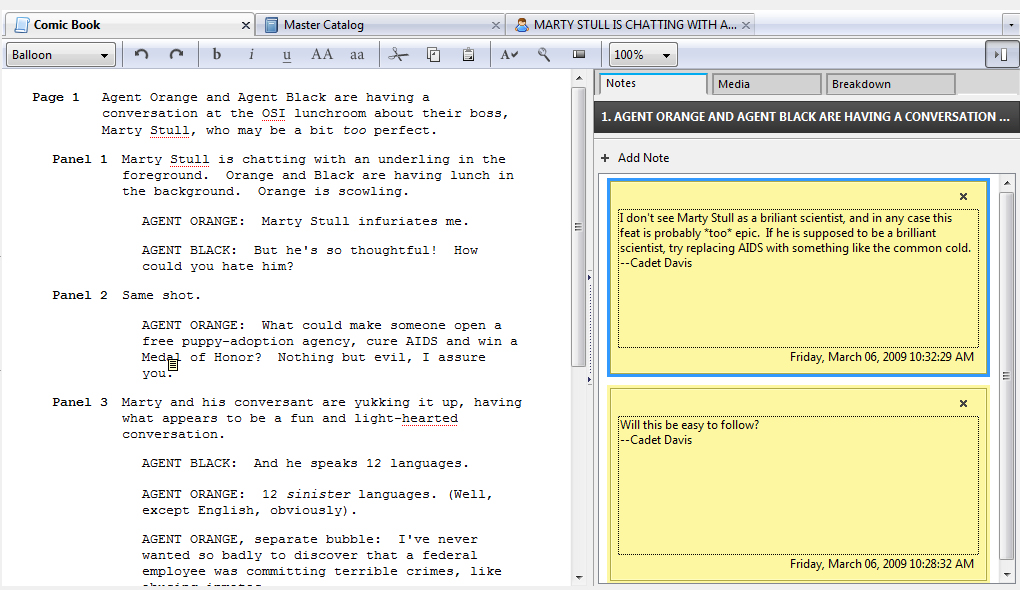
Celtx is a free scripting program that is designed for comic books (among other types of scripts).  I find it very useful.

THE EXCELLENT

  • It produces scripts that are generally easier to read and navigate than Microsoft Word.
  • Easy to learn.  It took me 10 minutes to figure it out by trial and error.
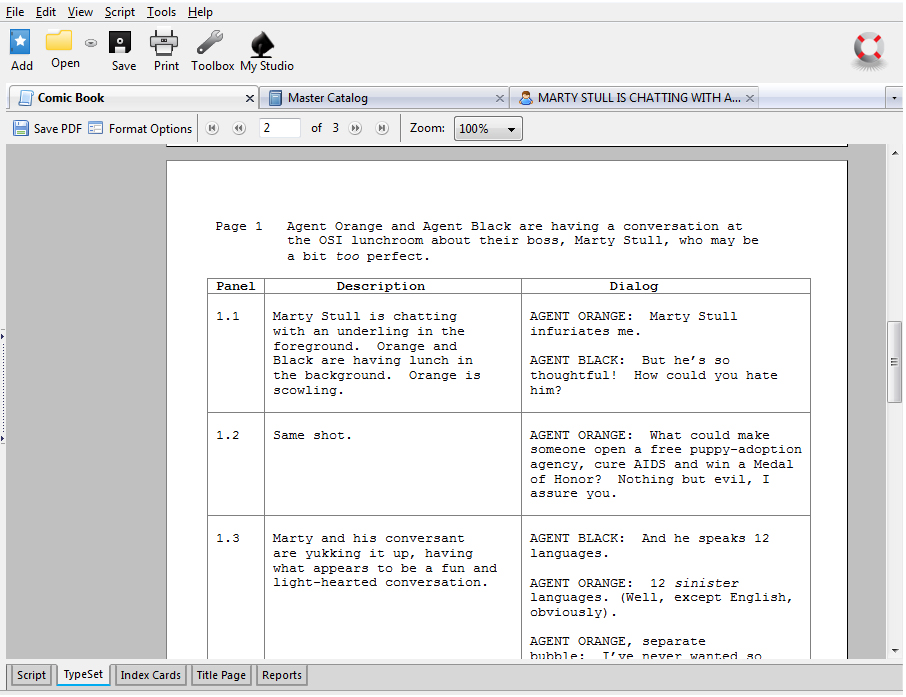
  • It’s extremely good at converting scripts into typeset.  (You can see an example here).  A typeset separates the in-panel text (like dialogue, captions and sound effects) from the text that won’t actually appear in the panel, like your directions to the artist.  That’s useful because it helps you gauge how large the panels will have to be to accommodate the text.
  • It’s free!

THE GOOD

  • Handles comments notably better than Word.
  • It’ll help you keep your comic book documents separate from your other files.
  • If you like to fill out index cards with important details about characters or places, it can help keep those details accessible and organized.
  • Built-in spellchecker.  Not that important for a professional proofreader, but you might find it helpful.

THE BAD

  • It’s not as easy to add dialogue as new pages or panels.
  • They should add buttons for New Panel and New Page.
  • It can’t save scripts as Word files.  Everybody (like friends and editors) is comfortable with Word.  Right now, if I have a Celtx script that I want to show you, I have to also tell you how to download Celtx and pray that you figure out the software quickly.

One last note. I haven’t had a chance to test its printing capabilities yet.  Given that Celtx can’t produce Word files (as far as I know), its ability to print usable scripts is essential.

30 responses so far

Mar 06 2009

Which superhero-related sites do you like best?

For superhero comedy, I’m a fan of the International Society of Supervillains and Evil, Inc.

I’ve come across a few interesting comic book review sites, but I haven’t had nearly as much success finding sites for people that want to write comic books.  Except for Superhero Nation, the closest thing I’ve found is Twelve Fingers.  For example, I found 10 Writing Tips for Comic Book Writers very informative.  However, TF is hard to navigate.

So, which websites would you recommend?

6 responses so far

Mar 05 2009

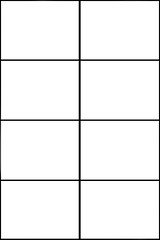
Experimental Panel Layouts

The typical comic book page is a grid of panels. That’s fine, but it can get boring. This article will help you play around with your panel layout. Your pages don’t all have to look like this.

Continue Reading »

74 responses so far

Mar 01 2009

A brief thought on success

There are two kinds of successful worker:  entrepreneurs that start their own projects, and professionals that the entrepreneurs trust enough to bring onto those projects.

1. Did you start any big projects this past year, like trying to write a novel or comic book?  Did you succeed?  Why or why not?  What project could you start this year?

2. Have you cultivated any relationships with the sort of people that are likely to help you be successful? For example, if you want to become a writer, developing a relationship with professional writers, editors and/or literary agents is wise.  (“Hey, B. Mac.  This chapter doesn’t feel like it’s working.  Could you give me some suggestions?”) If you want to write comic books, you’ll probably also benefit from friends that are talented artists.  Even if your networking is as rudimentary as making a few contacts through an art-site like DeviantArt, that’s a good start. Even if you don’t end up hiring them to be your artist, they can still provide valuable feedback. (“This page doesn’t look right. Any suggestions?”)

3. Have you cultivated any relationships with the people that are likely to start projects you’d like to work on?

No responses yet

Feb 25 2009

Comic Book Writing Tip of the Day: Sell the Next Issue

I’m very fond of Spiderman Loves Mary Jane, particularly the way it ends its issues. The last page of each issue wraps up the plot of that issue and foreshadows the next issue.  The cliffhangers are usually pretty strong and make the reader want to keep going.  For example, check out these sample concluding pages.

Continue Reading »

30 responses so far

Feb 14 2009

Common Superhero Day Jobs, Part 1

Continue Reading »

82 responses so far

Feb 14 2009

How to Give Your Superhero A Day Job

If your superhero has a secret identity, he probably has a day job.  Here are some tips for picking an effective day job.

Continue Reading »

130 responses so far

Jan 26 2009

“Ma’am, your son’s been murdered.”

CNN just did a piece on how cops break the news that someone’s loved one has been murdered.  I think the article is an especially useful resource for the authors of superhero stories because a lot of superheroes get so caught up in their superhero identities that regular people are essentially cut from the story.  For example, on Heroes normal people are sometimes used as props or plot devices, but they never get any important lines.   (Also, the characters haven’t had real jobs since season 1, and all of the recurring characters have superpowers now. Even Suresh and Ando!)

Although breaking tragic news to a spouse might get too angsty, I suspect that an author could play it quietly to add emotional depth to the superhero.  One of the things that annoyed me about Bruce Wayne/Batman is that he’s so socially retarded that it seems like he doesn’t care about anyone else.  Beating the hell out of bad guys is fine, but that’s just revenge for Batman.  If your hero is supposed to be likable, you might want to show that he’s at least trying to empathize with regular people.  I’d recommend having him stumble awkwardly in the conversation, though.  I think the scene depends on the awkwardness of the hero being thrust into a new role that’s hard even for professional chaplains.

What do you think?

2 responses so far

Dec 29 2008

Writing Tip: Start Your Story As Everything Goes Wrong

Generally, a book has only 5-20 pages (depending on audience age and genre) to establish three critical elements.

  1. The status quo of the main character.  What is this character like before everything goes wrong?  In the Lord of the Rings, for example, Frodo celebrates Bilbo’s birthday before being called upon to save the world.  In Superhero Nation, Gary is a workaholic accountant.
  2. The inciting event.  What throws the character off his status quo?  Usually, this is the point at which everything starts to go wrong.  For example, in Superhero Nation, Gary narrowly survives a car-bombing very early on.  This forces several changes on him:  first, he is transferred away from his job for his safety.  So he’s completely out of his social comfort zone.  Second, assassins are now trying to kill him.
  3. A goal for the main character.  This is usually a response to the inciting event.  This can be as simple as “I want everything to return to normal.”   Gary wants to rebuild his life by getting a job somewhere and he wants to survive the assassins.  This brings him to the superpowered Office of Special Investigations.  Wacky hijinks ensue!  (Buy the book when it finally gets published, heh heh).

A lot of manuscripts get bogged down in details that are typically too far removed from these three goals.

  1. Prologues.  They usually lack immediacy and, far too often, they just skip the main character entirely.  Ick.  The main character is almost always the best available way to hook readers into your story.
  2. Backstory.  Typically, it doesn’t really matter what your character was doing 5 or 10 years ago.  Readers want to know what’s happening now.  If you are literally unable to start the story without explaining what happened 5 or 10 years ago, you may wish to reevaluate the starting point for your story.  Ahem.  “If your backstory is more interesting than your current era, you’re writing the wrong story.”  If you have to introduce backstory, try to keep it to a bare minimum. Tell us only what we need to understand what is going on now.
  3. Side-characters.  If the side-characters are the best hook to your story, there’s probably something wrong with the main character and/or the plot.  For example, if a fantasy novel wants to show us the parents of the hero right before he is born, that will trap us in backstory.  Furthermore, will readers care about the hero’s parents?  Probably not.  If they were the most interesting characters in this book, they would be the leads.  Harry Potter #1 was very well-written, but it made a questionable choice to start the book when Harry was an infant.  It was a very slow beginning.
  4. Elaborate settings.  Typically, the main character is a better hook into the story than the world is.  A strong character can be relatable and likable, mostly unlike a strong world.  Try to limit the setting at the very beginning to just what we need to understand the main character and the plot.

I originally wrote this article for novelists, but it’s largely true for comic-book writers as well.  The main difference is that a comic-book writer has even fewer pages to establish the status quo.  What is your Peter Parker like before he becomes Spiderman?  If your character has a particularly interesting origin story, I’d recommend giving the status quo no more than half an issue (12 or 16 pages, probably).  But readers tend to appreciate introductions that are much shorter. A good establishing shot is typically sufficient and lets you get to the interesting stuff faster. (I love alternate identities as much as anyone, but usually the superhero identity is more gripping.  Would you want to read a comic called The Amazing Peter Parker or Clark Kent/Bruce Wayne?)

In a comic that probably ranges from 24-32 pages, you really need to get to the inciting event (probably the radioactive spider-bite or however else your hero got his powers) as soon as possible.  In a superhero story, I’d recommend giving the hero his powers early enough in the first issue that you can introduce his goal.  Ideally you can conclude the first issue with a fight or some other climactic event that gives you some room to offer some resolution (which satisfies readers) while setting up a greater conflict that will leave the readers wanting more.

120 responses so far

Dec 12 2008

How is your story better than its competitors?

The guys at Atomic Robo compiled a Few Simple Rules to keep their work from making the same mistakes as other comic book series.

…maybe it’s unfair to say that we “hate” comics. More accurately, we hate the reality of the state of American comics today; what comics have become… We see so many titles making the same mistakes that pushed us away from comics in the ’90s, and the tragedy is that these are wholly unnecessary elements and easily remedied. But it feels like no one ever does.

They have five solutions.

  1. No angst.
  2. No “cheesecake” (ass-shots of women and other distasteful treatment).
  3. No reboots. When something happens, it can’t unhappen.
  4. No filler.
  5. No delays.

I really like those, and I will add eight rules for my work.

Continue Reading »

148 responses so far

Nov 14 2008

DAMN!

Reading through The Watchmen, I notice that they used Captain Carnage as a minor character.  Damn!  I loved that name.

No responses yet

Nov 05 2008

Why Secret Origins Are Usually Awful

Occasionally, an author will breathlessly offer some revelation about a character’s origin.  (Luke and Leia are siblings!  Sylar is actually a Petrelli! That mysterious old man is actually a god!)  Secret origin stories are rarely effective.  If you’re doing a secret origin, here are the biggest potential concerns.  If you can avoid these, I think the secret has promise.

Continue Reading »

105 responses so far

Oct 29 2008

Aha! I think I’ve invented a superpower.

It’s ridiculously hard to come up with unique superpowers, but let’s try this.  The ability to inflict blindness.  I suspect it would work pretty well in novels and comic books.

42 responses so far

Oct 24 2008

When parodying superheroes, you can do better than lampooning their clothes

Superhero parodies are very hard to write. Generally, you can’t parody something that treats itself as ridiculous to begin with.  This means that poking fun at ridiculous elements of superhero stories, like what superheroes wear, is usually unsuccessful. Fortunately, many elements have more comedic potential because the stories take them seriously.

1. Superhero origin stories have always been outlandishly tragic, but since roughly 1990 it has just been ludicrous. Instead of just watching his loved ones get murdered, the hero might get betrayed by the CIA, set on fire, sent to hell and then return as some sort of crazyass demon-hunter.

2. As superhero stories progress, the writers run out of material and the likelihood that the stories will take bizarre twists approaches 100%. He’s a clone! His parents were superspies! His aunt marries a supervillain! His girlfriend falls for a werewolf! He grows six arms! He writes his girlfriend out of history by making a deal with the devil! And that’s just Spiderman. Don’t even get me started on the total strangeness surrounding Jimmy Olsen.

Continue Reading »

4 responses so far

Oct 22 2008

Three Qualities of Interesting Villains

One of the signs that your villain doesn’t suck is that he’s interesting enough to handle a scene on his own.  No, we don’t need to hear about his pathetically traumatic family history or the byzantine machinations of his evil organization.  Readers just need some sign that your villain has the competence, style and/or ambition that mark a good villain.


Competence

Your villain should not be out of the hero’s league. In fact, for most of the story, the villain should probably be winning against the hero.  One common misconception is that the hero will seem less impressive or likable if the villain beats him a few times.  No!  A hero that defeats a crazy-competent villain will resonate more.  For example, the only reason anyone remembers Luke Skywalker is because he defeated Darth Vader.


Fortunately, you can make your villain competent fairly easily. When your hero attempts some course of action, take 15 minutes to list anything that could go wrong.  Then list anything that your villain could do to make the hero fail even more spectacularly.  Your villain only has to exploit one glaring weakness in the hero’s plan to look competent.  Does the hero’s plan require logistical support from his Batcave?  Whoops. Even if your villain can’t take down the Batcave, he could try something like an EMP or sunspots to interfere with communications signals. Is the hero unable to teleport around town?  Throwing him off with a decoy could buy the villain enough time to carry out his real plan.


Style
Style is harder to pin down than competence, but there are still a few discernable signs of style.  A stylish villain tends to dominate his scenes, even if he doesn’t have many lines.  For example, there were a few scenes in the first season of Heroes that Sylar dominated even though he wasn’t actually present.


One scene that particularly sticks out is when Parkman and his FBI partner were fumbling around one of Sylar’s icy murder-scenes.  First, there’s the horror factor.  Sylar is obviously an extremely depraved killer.  But more importantly, the gruesomeness of the murder is contrasted with the incompetence of the cops.  They have no idea what’s going on.  Sylar was more of a presence because he was obviously playing out of their league.


Ambition
I recommend giving your villain an overarching and genuinely sinister plan.  If your villain’s plan is only to get revenge against a few people, the stakes of your hero failing will be very low.  For example, the first Spiderman movie dropped the ball on this one.  What would the stakes of Spiderman not fighting the Green Goblin have been?  Pretty much nothing, unless you were on the board of directors of OsCorp.


This doesn’t mean that the villain’s plan has to endanger the world or universe.  That gets cheesy very fast.  But this goes to competence: a villain that’s only playing for small stakes (like trying to kill a few OsCorp businessmen) probably won’t seem very competent or frightening.  In contrast, Dr. Octopus’ plan was more ambitious and interesting even though it wasn’t particularly evil.  He wanted to perfect a crazy-ass scientific theory to redeem himself for killing his wife the first time.  Octopus’ plan had significantly higher stakes for Spiderman because he endangered many more innocent victims.  (Sorry, ruthless businessmen, but readers just don’t care about you).

192 responses so far

Oct 12 2008

Writing Tip of the Day: Don’t Forget the Fun

One of the most common reasons that superhero stories fail is that they try too hard to be serious and end up killing the fun.  This does not mean that a serious story has to be unfun (see Wild Cards).  But the line separating seriousness from insufferability is very fine.  Here are some signs that you’ve crossed it.

  • The story treats being super as if it is a chore or unpleasant burden.
  • All of the characters are completely familiar with having superpowers and/or being superheroes.
  • The characters are overly emo (Heroes).
  • The language is impossibly dense and/or melodramatic (The Superhero’s Closet).
  • The story pushes a political agenda (Civil War).

For example, let’s compare Heroes to Spiderman here. Tracy discovers her ice-powers by accidentally killing someone and tests them by destroying a rose.  In the Spiderman movie, Peter Parker discovers his superpowers by finding out that he no longer needs glasses and tests them by trying to sling his way across town in a comically inept fashion.  Parker’s story features enthusiasm and positive energy.  Tracy’s story is laced with emo wangst. It doesn’t help us relate to her or see through her eyes.  Worse, it prevents viewers from wanting to see through her eyes.

2 responses so far

Oct 09 2008

“Yet Another Comics Blog” argues against origin stories

Yet Another Comics Blog argues that origin stories are mostly a distraction from the real action.

The origin is not the interesting story; it’s background information. If the information in the origin is important to the story you’re telling, then you can go back later and fill in for the reader. But don’t start with an issues-long origin…

Think of all the good genre movies you’ve ever seen. How many begin with a long origin sequence? Did Raiders of the Lost Ark start with 45 minutes of young Indiana Jones getting his PhD in archaeology? Did Star Wars begin with the origin of Darth Vader?

I disagree.  A character is usually the most human and relatable during his origin story.  Additionally, for most superheroes they also provide an irreplaceable opportunity to introduce the audience to the character.  For example, an author couldn’t explain who Spiderman is without showing why his uncle died.

Also, Star Wars did not begin with the origin of Darth Vader, but it did explain Luke’s origin at length.  Over the course of three movies we saw a farmboy grow into the savior of the universe.  It worked quite effectively.  I’d also venture that the first Matrix movie benefitted from Neo’s origin story.  If it had started with Neo after he had been released from the Matrix, it would have been horribly confusing.

The author praises Batman but criticizes Spiderman and Superman for spending too much time on origin.  But these are exceptional cases.  Usually, the audience is completely new to the backstory.  If so, then explaining the character’s origin is probably essential to introducing the audience to the world and/or the character.

14 responses so far

Oct 03 2008

A Random Name Generator

Not sure what to name your superhero’s alternate identity?  This name generator can give you hundreds of suggestions based on US census data.  Also, its names are surprisingly ethnically-diverse.

25 responses so far

« Prev - Next »