Feb
27
2010
I'm a former assistant editor with advice about how to write novels, comic books and graphic novels. Most of my content applies to fiction-writing in general, but I also provide articles specifically about superhero stories.
Superhero funerals are so common that they have their own page on ComicVine and usually so bland that they tend to run together. Given a transcript for three pages from a superhero funeral, can you name the series? If the writing were actually distinct, that wouldn’t be difficult.
Continue Reading »
Jan
28
2010
Opening with the characters in combat can be tricky because the characters can’t speak as naturally. For one thing, if your superheroes have secret identities, they’d be bloody stupid to blab about their day jobs when they’re surrounded by enemies (more on that later).
Continue Reading »
Jan
03
2010
1. Marvel and DC Comics don’t consider unsolicited submissions. Fortunately, Optimum Wound has a useful list of publishers that do. If you’re dead-set on working with Marvel or DC, I’d recommend taking a job with them in some other capacity (such as editing, sales or marketing) and then moving laterally into writing.
2. Most publishers won’t evaluate a comic book submission unless it has ~5 illustrated sample pages. This means that a writer will usually need a professional-grade artist friend willing to work for speculative pay, a paid freelancer or the skill to illustrate his own work. If you don’t know any artists and don’t have $500-750 for a freelancer, I’d recommend submitting to Dark Horse or another publisher that doesn’t require art samples. However, if you can pull off a competent art sample, it will really help your submission.
3. Pretty much no one considers proposals for licensed works. Do you have an awesome idea for a Star Wars or Buffy comic? Unfortunately, with licensed works, the publisher will almost always contact the writer it wants to work with rather than vice versa. Additionally, when they need a writer for a major series, they will hire someone experienced and proven rather than an unpublished author. Sorry. If you want to write for Spiderman or Batman, you need to establish yourself first.
4. Comic book companies usually buy the rights to the series and characters. In contrast, novel series are almost always creator-owned. If you really care about maintaining ownership over your characters and stories, I’d recommend looking at Image Comics. Almost all of their series are creator-owned.
Continue Reading »
Nov
15
2009
When you’re ready to submit your novel or comic book to an agent or publisher, these tips will help you make the sell.
1. The only goal of your submission is to convince a publishing professional that your novel or comic book is likely to sell thousands of copies. Nothing else matters.
2. Follow the instructions on their website. Most agents and publishers will have submissions pages that lay out what they want to see. In most cases, it’s best to provide just what’s on the list and nothing else. (Exception: if you’re submitting a comic book script, consider submitting some inked or colored pages even if they aren’t required– these pages will help the editor decide very quickly whether your proposal is serious).
3. Check your spelling, punctuation and grammar. Trying to impress a publishing professional without clean writing is like trying to run a filthy restaurant. It really doesn’t matter how good the cooking is– customers will run out screaming anyway. Proofread or perish. Not many publishing professionals would bet tens of thousands of dollars on an unpolished writer.
Continue Reading »
Nov
09
2009
1. READ THE INSTRUCTIONS. The instructions take precedence over everything else. If you fail to meet the guidelines provided by the comic book publisher on its submissions page, you are dead on arrival. For example, you can see Dark Horse’s submissions guidelines here and Image’s here. (By the way, Marvel and DC don’t accept unsolicited submissions– either they call you because they’re impressed by what you have already published, or you start working for them in some other capacity and move laterally)
Continue Reading »
Oct
13
2009
A recurring problem for young writers is that we are more likely to try crazy-complicated sets of superpowers. Don’t waste paragraphs describing each character’s powers. That’s space you could be using to develop personalities, character traits, the plot, relationships, etc. As a rule of thumb, I would recommend keeping it simple– if you need more than 20 words to describe a character’s powers, there’s probably too much going on.
Continue Reading »
May
26
2009
Magical superheroes are rare and haven’t sold very well since the Silver Age of comics (late 1950s and 60s). Here are some tips to help you write a magical superhero story that a publisher might take seriously.
1. Do it as a novel, not a comic book. Comic books depend on male readers aged 13-25. The problem is that the people that are most receptive to magical superheroes (kids and women) generally do not buy comic books. This is one reason that magical superheroes are very, very hard to publish as a comic book. The magical superhero stories that tend to sell even remotely well tend to be TV shows (Sailor Moon or Jake Long) or novels (Dresden Files).
2. If you are absolutely dead-set on a comic book, I recommend using Japanese-style art. American teens are somewhat more tolerant of magic in anime stories like Sailor Moon than they are of American-style stories like Dr. Strange or Zantanna.
Continue Reading »
May
17
2009
1. Shrinking. First, this is a horribly cliche type of story. Second, it is pretty much impossible to do anything fresh with it. The characters get shrunk, deal with some tiny obstacles (usually including a cat or some other suddenly dangerous animal), and then get their size back. What else could you do with it?
How can I do it right? Have the character stays shrunken for longer than just an issue. It’ll push you to develop the formula in a fresh direction, and hopefully one more fertile than “and then they discover a microscopic civilization!”
2. Body-swapping. One character switches bodies with another, usually involuntarily. The drama usually comes from the characters having to survive despite having different powers or having to play different roles than they’re used to.
How can I do it right? This isn’t necessarily bad, but it has been done extensively. It tends to work best if the characters have to keep their identities secret. If Jim and Luke can just tell everyone that their bodies have been swapped, it’s not really an interesting obstacle. But if Jim and Luke can’t talk about magic or the supernatural hijinks they’re involved in, then body-swapping makes it that much harder for them to keep up the masquerade. Give them difficult situations they can’t duck. For example, “Luke” suddenly has a piano concert and “Jim” is now the starting quarterback. The only way for them to protect the secret is to learn (or feign competence in) something totally new. Good luck!
Also, I strongly recommend against switching characters of different genders or species. It’s got a lot of potential for creepiness.
Continue Reading »
Mar
09
2009
These are some of the biggest comic book companies. Knowing which publishers are geared towards your style of writing or art will help you decide which publishers to apply to. (Please note that I tried to stay away from publishers that I know will not accept unsolicited queries, like Marvel and DC Comics).
Continue Reading »
Mar
08
2009
This should be pretty obvious, but unfortunately it isn’t. When you submit a novel manuscript or a comic book script, pick your prospective publishers carefully. Make sure you submit it to publishers that actually work with stories that have a lot in common with your story.
- Audience (age and gender)
- Genre and content
- Style/mood
- Setting (real-world Earth vs. historical vs. the future vs. a Tolkien-like fantasy world)
- Length, for books (length usually goes hand-in-hand with the age of the audience)
- Art style, for comic books (dark and gritty vs. Western cartoons vs. anime/manga, for example)
Prospective publishers love it when authors put some thought into this. If your query clearly shows that you have looked into which publishers will be the best fit for your book, you will look professional and competent. A good place to start is looking up 5 or 10 comparable works on Amazon. Where did they get published? For comic books, which editors signed on? That should give you a few publishers to look into.
I’ll use a very particular example to show how easy this is. For example, right now I’m looking for publishers that would be interested in a guide for how to write superhero novels and comic books. It’s aimed at teens. Many publishers have printed books for kids that want to write, so finding apt publishers shouldn’t be a problem. I’d also like to look at publishers that have printed guides about writing comic books.
After 30 minutes on Amazon, I found ~10 works that seemed comparable at first glance. Let’s look at why these works might or might not suggest that their publisher would be interested in mine…
Continue Reading »
Mar
06
2009
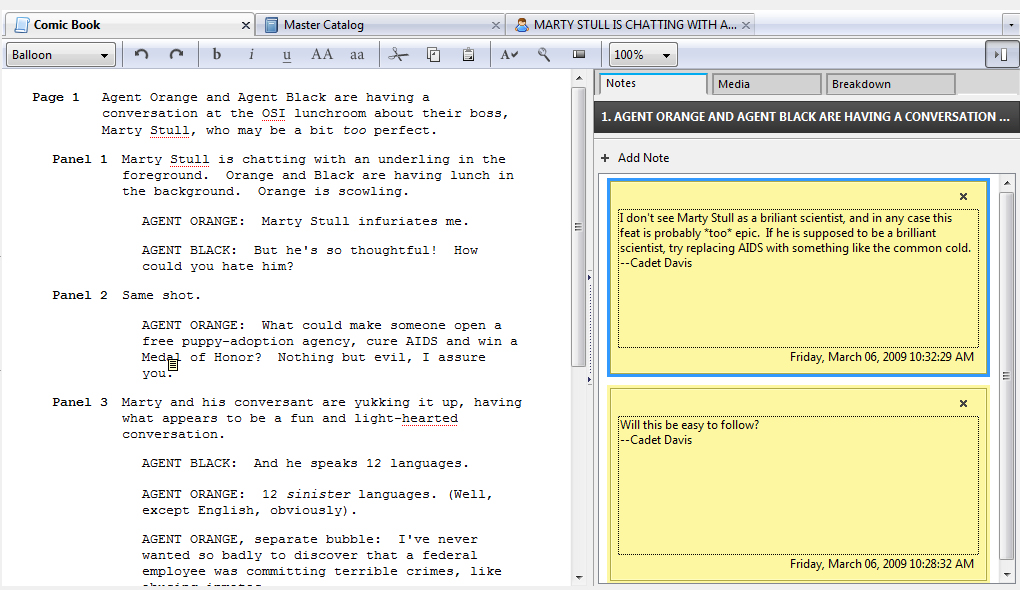
Celtx is a free scripting program that is designed for comic books (among other types of scripts). I find it very useful.

THE EXCELLENT
- It produces scripts that are generally easier to read and navigate than Microsoft Word.
- Easy to learn. It took me 10 minutes to figure it out by trial and error.
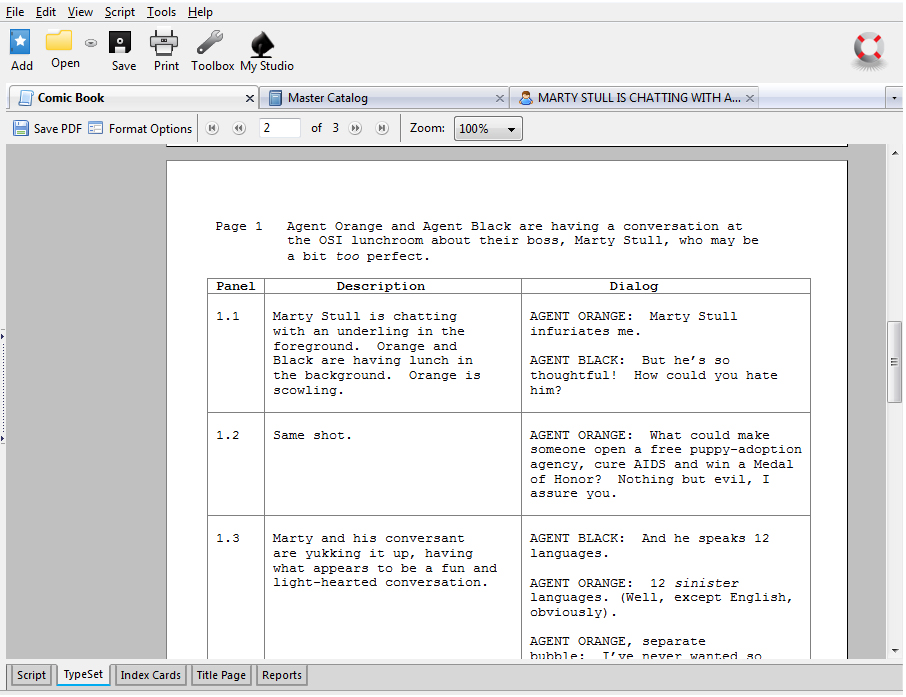
- It’s extremely good at converting scripts into typeset. (You can see an example here). A typeset separates the in-panel text (like dialogue, captions and sound effects) from the text that won’t actually appear in the panel, like your directions to the artist. That’s useful because it helps you gauge how large the panels will have to be to accommodate the text.
- It’s free!
THE GOOD
- Handles comments notably better than Word.
- It’ll help you keep your comic book documents separate from your other files.
- If you like to fill out index cards with important details about characters or places, it can help keep those details accessible and organized.
- Built-in spellchecker. Not that important for a professional proofreader, but you might find it helpful.
THE BAD
- It’s not as easy to add dialogue as new pages or panels.
- They should add buttons for New Panel and New Page.
- It can’t save scripts as Word files. Everybody (like friends and editors) is comfortable with Word. Right now, if I have a Celtx script that I want to show you, I have to also tell you how to download Celtx and pray that you figure out the software quickly.
One last note. I haven’t had a chance to test its printing capabilities yet. Given that Celtx can’t produce Word files (as far as I know), its ability to print usable scripts is essential.
Mar
06
2009
For superhero comedy, I’m a fan of the International Society of Supervillains and Evil, Inc.
I’ve come across a few interesting comic book review sites, but I haven’t had nearly as much success finding sites for people that want to write comic books. Except for Superhero Nation, the closest thing I’ve found is Twelve Fingers. For example, I found 10 Writing Tips for Comic Book Writers very informative. However, TF is hard to navigate.
So, which websites would you recommend?
Mar
05
2009
The typical comic book page is a grid of panels. That’s fine, but it can get boring. This article will help you play around with your panel layout. Your pages don’t all have to look like this.

Continue Reading »
Dec
30
2007
Generic Physical Abilities
- Superstrength
- Speed
- Durability
- Agility/reflexes
- Healing/regeneration
- Supersenses
- Sight/hearing/smell/taste/touch
- Sensing danger (spider-sense)
- Sensing other types of events (dishonesty, murder, etc.)
- The ability to remove senses (like inflicting blindness, etc.)
- Longevity/immortality
Forms of Transportation
- Climbing/wall-crawling
- Swimming/water-breathing
- Flight
- Teleportation
Time-Based Abilities
- Temporal manipulation (like The Matrix)
- Time travel
- Prophecy
Elemental Control/Manipulation
- Basic elements (fire, electricity, water, earth, wind)
- Light and/or darkness
- Gravity
- Magnetic forces
- Radiation
- Energy
- Sound
- Nature
Generic Mental Abilities
- Skills and/or knowledge
- Popular categories: science, mechanical, computer/electronics, weapons-handling/military, driving, occult/magical.
- Super-intelligence
- Resourcefulness (“I’m never more than a carton of baking soda away from a doomsday device”)
Psychic Abilities
- Telekinesis (moving objects mentally)
- Telepathy (reading minds)
- Mind-to-mind communication
- Mind-control
- Possession (total mental control)
- Memory manipulation (may include creation/alteration/deletion)
- Mentally generated weaponry
- Mindblast
- Ability to locate someone mentally
- Forcefields
Biological Control
- Acid/poison
- Controlling plants and/or animals
- Animal morphing
- Ability to take on someone else’s appearance
Miscellaneous
- Elasticity
- Self-destruction
- Self-liquification
- Gaseous form
- Growth/shrinking
- Self-duplication
- Invisibility
- Absorbing someone else’s powers
- Negating someone else’s powers
- Luck manipulation (good luck for hero and/or bad luck for enemies)
- “Psychometry”– the ability to learn things about the past or future of an object by touching it
- Illusions
WAYS TO DISTINGUISH YOUR SUPERHERO’S SUPERPOWERS
- Your story’s superpowers have some cost to the user.
- Fatigue. Your hero’s powers exhaust him.
- Equal and opposite reaction. Perhaps your supergenius’s brain will overheat unless he lets his mind cool down after a mental stunt.
- Energy. Your hero has a drainable and finite source of power.
- Risk to self (or others). Your hero’s powers, once activated, are hard to control and dangerous.
- Personality shift. Activating your hero’s powers transforms his personality or mindset, like the Hulk or Catastrophe.
- Loss of sanity. Your hero’s transformation makes him considerably less stable, like The Hulk or Niki.
- Your story’s superpowers have a limited duration or accessibility.
- His superpowers only last a certain duration and have to be recharged.
- His superpowers can only be accessed after a certain condition is met or at a certain time of day. For example, Captain Marvel has to say Shazaam first.
- His superpowers are only accessible after he transforms (like the Hulk or American Dragon).
- Superpowers are accessible only through a particular item, usually a magical or technological item (Sailor Moon, power armor).
- Your superpowers have an unusual origin or source.
- Because the hero’s alien or otherwise unhuman (Superman, TMNT)
- Because he’s a modified human (Spiderman, cyborgs)
- Because he has some artifact (power armor)
- Your superpowers have unusual limits
- Physical. Maybe his electricity shorts out in water or he gets really weak when exposed to Kryptonite.
- Time. Hourman’s powers only last (you guessed it) an hour.
If this list helped you, please see our list of superhero writing articles.
Did this article help? Submit us to Stumble!