Mar 30 2009
A Few Problems with Print-on-Demand
The Science Fiction and Fantasy Writers of America have an interesting article on some of the problems with POD self-publishing. In summary…
Mar 30 2009
The Science Fiction and Fantasy Writers of America have an interesting article on some of the problems with POD self-publishing. In summary…
Mar 27 2009
Novelists write a query to convince a literary agent or publisher that…
The formatting depends on which literary agency or publisher you’re submitting to, but usually it will feature the following sections:
Mar 26 2009
If you have any questions about formatting a comic book script or novel manuscript, or any questions about grammar/punctuation/capitalization, please post them here.
Mar 25 2009
When a first-time novelist says that he’s writing the first book in a series, that’s usually code for “I’m not going to resolve anything.”
For example, the story builds up to a “climactic” battle that doesn’t actually vanquish the villain. The main sidegoal is to get the girl, but the hero doesn’t manage to accomplish that, either. After reading hundreds of pages, your audience will want some resolution. If your novel can best be summarized as “to be continued,” then what’s the point?
Here are some better ways to set up sequels.
Mar 24 2009
Grant proposals for the Xeric Foundation have to be postmarked by March 31. Xeric helps underwrite some of the cost of self-publishing. Self-publishing is highly dangerous, especially for new authors, but grants like these can help minimize your financial liabilities if the project flops. If you’re interested in applying for a grant, please let me know if I can provide any advice with the proposal.
Mar 22 2009
Last week, I discussed why self-publishing is an awful idea for young writers. Here are some of the reasons that self-publishing might make sense for you.
Mar 22 2009
Slate’s Jacob Weisberg argues that the Kindle will totally reshape the publishing industry. Not likely.
Mar 22 2009
My query letter to literary agents is coming along really well! This is the first major writing success I’ve had in the last month.
Mar 21 2009
I’m planning for the contingency that someone beats me in our proofreading contest next month. So I need to design the t-shirt that I might give out. My original plan was to just give out a generic Superhero Nation t-shirt, but I’d like to design a separate “I Beat B. Mac” t-shirt.
On the front, I think it will have something like a Che Guevara-esque drawing of me with the caption “I Beat a Professional Proofreader And and All I Got was This Lousy T-Shirt.” That’s kind of cliche, so hopefully one of you can suggest something more stylish.
There will be text on the back. For example, something like “What are you waiting for? Beat B. Mac and win this shirt on SUPERHERONATION.COM”
Mar 18 2009
Hello. I have an exciting new game for the grammatically inclined. Compete with B. Mac in a proofreading contest. Those that can score 80% as many points as BM will be eligible for a volunteer moderator position. Those that score more points than B. Mac will also receive a free Superhero Nation t-shirt. (I’m judging the contest, but I’ll be fair). If you’d like to compete, please download the following document and email your completed version to superheronation-at-gmail-dot-com. The contest ends on March 27!
Mar 13 2009
Unfortunately, many literary agents are dishonest and/or incompetent. Here are some tips to help you select an agent that knows what he’s doing.
Mar 13 2009
Site titles play an important role in search engine optimization. A site named “Superhero Nation: a writing advice site” has a much better chance to place for a search like superhero writing advice than a site named just “Superhero Nation.” Site titles also helps draw people into your website by explaining what viewers will get out of your website.
For example, check out how a typical search for Superhero Nation appears on Google. The site name plays more prominently than the name of the article does.
Mar 13 2009
Good literary agents only accept manuscripts with some potential, so having a good literary agent suggests to publisher that the work is worth looking at more closely.
According to Kris Waldherr…
“Of the hundreds (maybe thousand plus) of manuscripts I read during a six month period, only about 2% went onto consideration by an acquiring editor. None of them were acquired. This suggests why so many publishers have stopped reading manuscripts not submitted to them by agents or colleagues. Bottom line: reading unsolicited submissions is simply not cost effective.”
Mar 12 2009
If you’re thinking about self-publishing, particularly print-on-demand, please check out this estimate of some of your startup costs.
Mar 09 2009
These are some of the biggest comic book companies. Knowing which publishers are geared towards your style of writing or art will help you decide which publishers to apply to. (Please note that I tried to stay away from publishers that do not accept unsolicited queries, like Marvel and DC Comics).
Mar 08 2009
This should be pretty obvious, but unfortunately it isn’t. When you submit a novel manuscript or a comic book script, pick your prospective publishers carefully. Make sure you submit it to publishers that actually work with stories that have a lot in common with your story.
Prospective publishers love it when authors put some thought into this. If your query clearly shows that you have looked into which publishers will be the best fit for your book, you will look professional and competent. A good place to start is looking up 5 or 10 comparable works on Amazon. Where did they get published? For comic books, which editors signed on? That should give you a few publishers to look into.
I’ll use a very particular example to show how easy this is. For example, right now I’m looking for publishers that would be interested in a guide for how to write superhero novels and comic books. It’s aimed at teens. Many publishers have printed books for kids that want to write, so finding apt publishers shouldn’t be a problem. I’d also like to look at publishers that have printed guides about writing comic books.
After 30 minutes on Amazon, I found ~10 works that seemed comparable at first glance. Let’s look at why these works might or might not suggest that their publisher would be interested in mine…
Mar 07 2009
This is pretty much the most obvious writing advice I can think of. If this is your first novel or comic book, don’t self-publish unless you can afford for the project to completely flop.
Mar 06 2009
I have a very unusual request. If you’ve followed the webcomic very closely, you might remember that Agent Orange is a really bad author. However, he’s even worse at poetry and plays. During a scene I’m working on, Agent Orange uses his poetry (or playwrighting) to torture a confession out of a criminal. However, I’ve never really gotten into poetry, so it’s hard for me to simulate truly, spectacularly awful poetry (or plays). Would you like to take a go? I’ll probably only need 5-7 lines.
Mar 06 2009
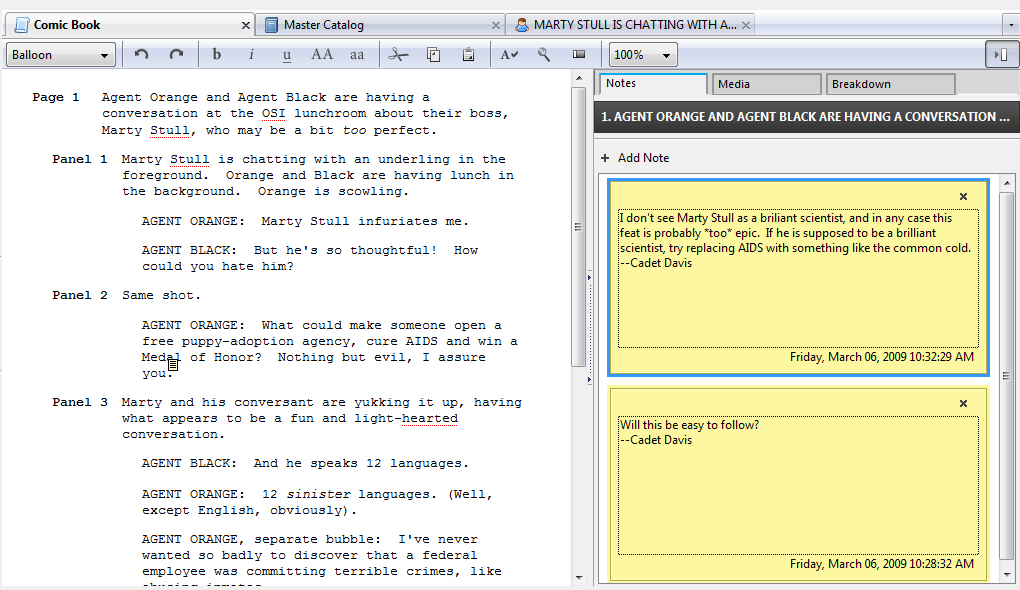
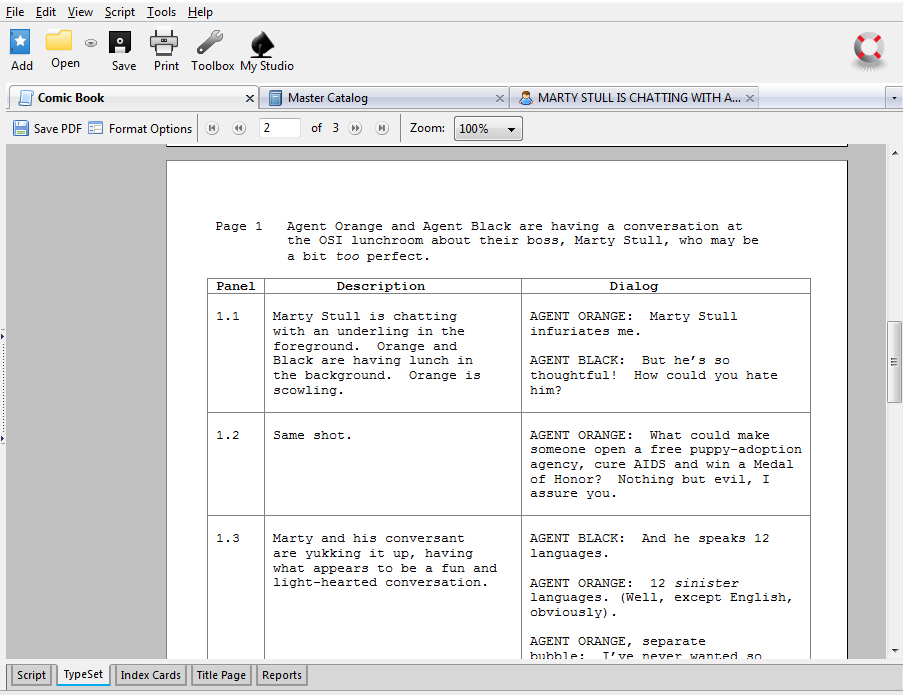
Celtx is a free scripting program that is designed for comic books (among other types of scripts). I find it very useful.
THE EXCELLENT
THE GOOD
THE BAD
One last note. I haven’t had a chance to test its printing capabilities yet. Given that Celtx can’t produce Word files (as far as I know), its ability to print usable scripts is essential.
Mar 05 2009
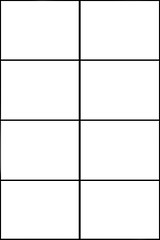
The typical comic book page is a grid of panels. That’s fine, but it can get boring. This article will help you play around with your panel layout. Your pages don’t all have to look like this.

Mar 04 2009
Hello! An acquaintance recently attempted suicide and, umm, I really feel that I should wish him well and offer whatever help I can, probably class help because that’s what I know how to do. We’re in the middle of midterms, so I would imagine that academic pressure is probably involved. I have a few concerns, though.
Any thoughts about how to encourage him tactfully?
Mar 02 2009
The synopsis is the most important part of a novel proposal. If the synopsis looks bad, the editor will toss the proposal without even looking at the chapters.
Mar 01 2009
There are two kinds of successful worker: entrepreneurs that start their own projects, and professionals that the entrepreneurs trust enough to bring onto those projects.
1. Did you start any big projects this past year, like trying to write a novel or comic book? Did you succeed? Why or why not? What project could you start this year?
2. Have you cultivated any relationships with the sort of people that are likely to help you be successful? For example, if you want to become a writer, developing a relationship with professional writers, editors and/or literary agents is wise. (“Hey, B. Mac. This chapter doesn’t feel like it’s working. Could you give me some suggestions?”) If you want to write comic books, you’ll probably also benefit from friends that are talented artists. Even if your networking is as rudimentary as making a few contacts through an art-site like DeviantArt, that’s a good start. Even if you don’t end up hiring them to be your artist, they can still provide valuable feedback. (“This page doesn’t look right. Any suggestions?”)
3. Have you cultivated any relationships with the people that are likely to start projects you’d like to work on?
Feb 28 2009
The words “villain” and “supervillain” are commonly misspelled. Don’t mess them up!
Feb 25 2009
Hi, I’m looking to get published. My prospective publishers want me to provide information about my audience. Specifically, are you interested in my book about how to write superhero stories? Would you prefer information tailored to novelists, comic book writers or both?
I would really appreciate 5 minutes of your help. Thanks!
Feb 20 2009
1. Read broadly and watch a lot of movies. If you’re only acquainted with a few well-known works, your stories will probably feel like they were heavily influenced by those stories.
2. Learn grammar, punctuation and spelling. It’s basic writing craft. THIS IS NOT OPTIONAL. It will be extremely difficult (if not totally impossible) to get professionally published if you don’t have a grasp on these basic writing skills. It’s sort of like showing up for basketball tryouts even though you don’t know how to dribble. You will be the first one cut. If your submission has glaring spelling and punctuation mistakes, you will be the first one cut.
3. Professional publishing is extremely competitive. Most novel publishers, for example, reject more than 99% of their manuscripts. If you’re daunted by rejection, this is not a good field for you. Unless you’re freakishly talented, expect to spend months rewriting before you get published.
4. Try to major in something other than English or creative writing. Having knowledge in a field outside of writing will give you more material to draw on, which will give you an edge over other authors. Even something like history or political science will give you amusing anecdotes you can draw on later.
5. If you’re really serious about becoming a professional author, I’d recommend attending a private university. First, their class sizes tend to be smaller across the board, so writing workshops will probably be more instructive. They also tend to offer more money for undergraduates interested in taking on creative endeavors.
6. Blogging is good experience. It can help you figure out what attracts an audience and what doesn’t. It can also help you create and sharpen ideas. For example, this writing blog has generated at least one book worth of material about how to write well.
7. Writing fan-fiction is generally not good experience. It’s better to try creating your own worlds, characters, plot-lines, etc. The material you generate will be fresher and easier to use later.
8. In writing, there are no points for effort or personal circumstances. You’re judged only on the quality of your product. Please don’t be one of the writers that pleads for the mercy of publishers because they suffer from (usually self-diagnosed) dyslexia or whatever. If something like dyslexia affects your writing, you have three options: overcome the obstacles yourself, have someone else deal with the problem (by proofreading your work, for example), or find a new line of work. Even if you are dyslexic, you will be held to the same standards of readability as everybody else.
9. Writing teachers mean well and can be great sources of advice, but remember to take all advice with a grain of salt. For example, maybe the teacher doesn’t have a style similar to yours. If so, his advice might just mean that he’s not a fan of your preferred kind of writing. For example, we tend to prefer mass-market comedies and action stories rather than denser, literary works. If we told you that your work was overwrought and didn’t move quickly enough, one possibility you should consider is that it’s moving fast enough for the kind of book you’re writing. I’d also recommend looking for literary agents that have experience selling books like yours.
Feb 03 2009
If you’d like to suggest any, I’d appreciate that. Here are some of the questions we’ve previously answered.
Feb 02 2009
Jan 27 2009
Thanks, I’d really appreciate it. Right now, the main thing I’m working on is character-design, specifically a mutant alligator that’s pretty much the Hobbes in a Calvin & Hobbes comic duo.
Jan 24 2009
Cadet Davis reviews and revises the titles of 30 manuscripts submitted to a writing workshop. This will help you evaluate and improve your titles.