Mar
12
2009
We provide advice about
how to write novels, comic books and graphic novels. Most of my content applies to fiction-writing in general, but we also provide
articles specifically about superhero stories.
It looks like Slicehost went down for a few hours and we went offline from about 4-7 am EST. I apologize.
Mar
10
2009
A Harvard professor and a Texan start talking at a bar. The Texan asks “Where ya from?” The Harvard professor says “Where I come from, we don’t end our sentences with prepositions.” The Texan asks “Where ya from, jackass?”
Mar
09
2009
These are some of the biggest comic book companies. Knowing which publishers are geared towards your style of writing or art will help you decide which publishers to apply to. (Please note that I tried to stay away from publishers that do not accept unsolicited queries, like Marvel and DC Comics).
Continue Reading »
Mar
08
2009
This should be pretty obvious, but unfortunately it isn’t. When you submit a novel manuscript or a comic book script, pick your prospective publishers carefully. Make sure you submit it to publishers that actually work with stories that have a lot in common with your story.
- Audience (age and gender)
- Genre and content
- Style/mood
- Setting (real-world Earth vs. historical vs. the future vs. a Tolkien-like fantasy world)
- Length, for books (length usually goes hand-in-hand with the age of the audience)
- Art style, for comic books (dark and gritty vs. Western cartoons vs. anime/manga, for example)
Prospective publishers love it when authors put some thought into this. If your query clearly shows that you have looked into which publishers will be the best fit for your book, you will look professional and competent. A good place to start is looking up 5 or 10 comparable works on Amazon. Where did they get published? For comic books, which editors signed on? That should give you a few publishers to look into.
I’ll use a very particular example to show how easy this is. For example, right now I’m looking for publishers that would be interested in a guide for how to write superhero novels and comic books. It’s aimed at teens. Many publishers have printed books for kids that want to write, so finding apt publishers shouldn’t be a problem. I’d also like to look at publishers that have printed guides about writing comic books.
After 30 minutes on Amazon, I found ~10 works that seemed comparable at first glance. Let’s look at why these works might or might not suggest that their publisher would be interested in mine…
Continue Reading »
Mar
07
2009
This is pretty much the most obvious writing advice I can think of. If this is your first novel or comic book, don’t self-publish unless you can afford for the project to completely flop.
Continue Reading »
Mar
06
2009
I have a very unusual request. If you’ve followed the webcomic very closely, you might remember that Agent Orange is a really bad author. However, he’s even worse at poetry and plays. During a scene I’m working on, Agent Orange uses his poetry (or playwrighting) to torture a confession out of a criminal. However, I’ve never really gotten into poetry, so it’s hard for me to simulate truly, spectacularly awful poetry (or plays). Would you like to take a go? I’ll probably only need 5-7 lines.
Mar
06
2009
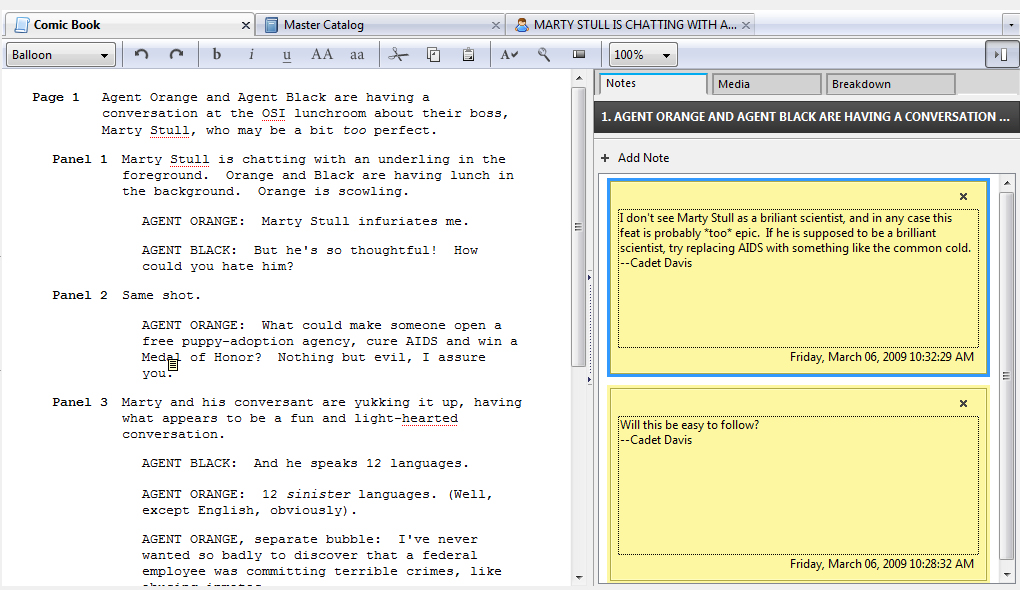
Celtx is a free scripting program that is designed for comic books (among other types of scripts). I find it very useful.
THE EXCELLENT
- It produces scripts that are generally easier to read and navigate than Microsoft Word.
- Easy to learn. It took me 10 minutes to figure it out by trial and error.
- It’s extremely good at converting scripts into typeset. (You can see an example here). A typeset separates the in-panel text (like dialogue, captions and sound effects) from the text that won’t actually appear in the panel, like your directions to the artist. That’s useful because it helps you gauge how large the panels will have to be to accommodate the text.
- It’s free!
THE GOOD
- Handles comments notably better than Word.
- It’ll help you keep your comic book documents separate from your other files.
- If you like to fill out index cards with important details about characters or places, it can help keep those details accessible and organized.
- Built-in spellchecker. Not that important for a professional proofreader, but you might find it helpful.
THE BAD
- It’s not as easy to add dialogue as new pages or panels.
- They should add buttons for New Panel and New Page.
- It can’t save scripts as Word files. Everybody (like friends and editors) is comfortable with Word. Right now, if I have a Celtx script that I want to show you, I have to also tell you how to download Celtx and pray that you figure out the software quickly.
One last note. I haven’t had a chance to test its printing capabilities yet. Given that Celtx can’t produce Word files (as far as I know), its ability to print usable scripts is essential.
Mar
06
2009
The New York Times has started compiling weekly best-seller lists for graphic novels (err, “graphic books”) in hardcover, paperback and manga. (Hat-tip to the Comics Reporter). The NYT argues that “comics have finally entered the mainstream.” Possibly.
1. I agree that superhero stories are mainstream. Many superhero movies and TV shows have been broadly successful.
2. But comic books and graphic novels are not mainstream. Primarily, that’s because they’re sold mostly in specialty stores rather than general-interest stores like supermarkets and newsstands. These specialty stores usually strike me as kind of creepy and may well scare away low-interest fans. Moving back into supermarkets probably isn’t feasible for the typical comic book series, but it encourages me that comic books are increasingly sold online.
[B. Mac adds: Is the endorsement of the NYT a good thing for comics? The NYT has a soft spot for businesses that are not actually economically viable, such as solar power, US car companies, and itself.]
Mar
06
2009
For superhero comedy, I’m a fan of the International Society of Supervillains and Evil, Inc.
I’ve come across a few interesting comic book review sites, but I haven’t had nearly as much success finding sites for people that want to write comic books. Except for Superhero Nation, the closest thing I’ve found is Twelve Fingers. For example, I found 10 Writing Tips for Comic Book Writers very informative. However, TF is hard to navigate.
So, which websites would you recommend?
Mar
05
2009
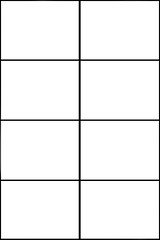
The typical comic book page is a grid of panels. That’s fine, but it can get boring. This article will help you play around with your panel layout. Your pages don’t all have to look like this.
Continue Reading »
Mar
04
2009
Hello! An acquaintance recently attempted suicide and, umm, I really feel that I should wish him well and offer whatever help I can, probably class help because that’s what I know how to do. We’re in the middle of midterms, so I would imagine that academic pressure is probably involved. I have a few concerns, though.
- I don’t want him to feel like people only care about him because he attempted suicide. (I mean, I run a website designed to help young adults write, so hopefully it’s easy to approach me for academic help).
- I don’t want to make him feel guilty or be the hundredth person to remind him about something he probably regrets.
Any thoughts about how to encourage him tactfully?
Mar
03
2009
Today we received our five-thousandth comment. Incidentally, today we also received our fifteen-thousandth piece of spam. According to Google Analytics, we’ve only had 65 Russian readers but somehow about a third of our spam is in Russian. Assuming that all of the Russian-language spam came from a Russian user, that would be an impressive 75 messages per user.
Mar
02
2009
The synopsis is the most important part of a novel proposal. If the synopsis looks bad, the editor will toss the proposal without even looking at the chapters.
Continue Reading »
Mar
01
2009
There are two kinds of successful worker: entrepreneurs that start their own projects, and professionals that the entrepreneurs trust enough to bring onto those projects.
1. Did you start any big projects this past year, like trying to write a novel or comic book? Did you succeed? Why or why not? What project could you start this year?
2. Have you cultivated any relationships with the sort of people that are likely to help you be successful? For example, if you want to become a writer, developing a relationship with professional writers, editors and/or literary agents is wise. (“Hey, B. Mac. This chapter doesn’t feel like it’s working. Could you give me some suggestions?”) If you want to write comic books, you’ll probably also benefit from friends that are talented artists. Even if your networking is as rudimentary as making a few contacts through an art-site like DeviantArt, that’s a good start. Even if you don’t end up hiring them to be your artist, they can still provide valuable feedback. (“This page doesn’t look right. Any suggestions?”)
3. Have you cultivated any relationships with the people that are likely to start projects you’d like to work on?